Fresh crab, provocative spices, wildlife-rich national parks, and French colonial heritage: There’s a lot to like about these coastal towns.

Chili sauce dripped down my chin as I dabbed the sweetness from the corners of my mouth. The fresh crab, with its striking resemblance to the Dungeness variety, was like nothing I’d eaten since I left my home in the Pacific Northwest four years ago.
Minutes earlier, it had been bathing in seawater off the pier at Kep, a fishing village and minor beach resort beside the Gulf of Thailand on the southern coast of Cambodia. Now it was on my plate, cracked and served with chopped chunks of garlic and strings of local Kampot peppercorns that lent a tantalizing aroma.
Judging from the number of cracked claws I counted, I must have consumed at least three crabs — a full kilogram, or 2.2 pounds. The price tag? In Cambodian riels, about 41,000. In US dollars? $10. (Rice and a can of Ganzberg beer brought the total to $11.)
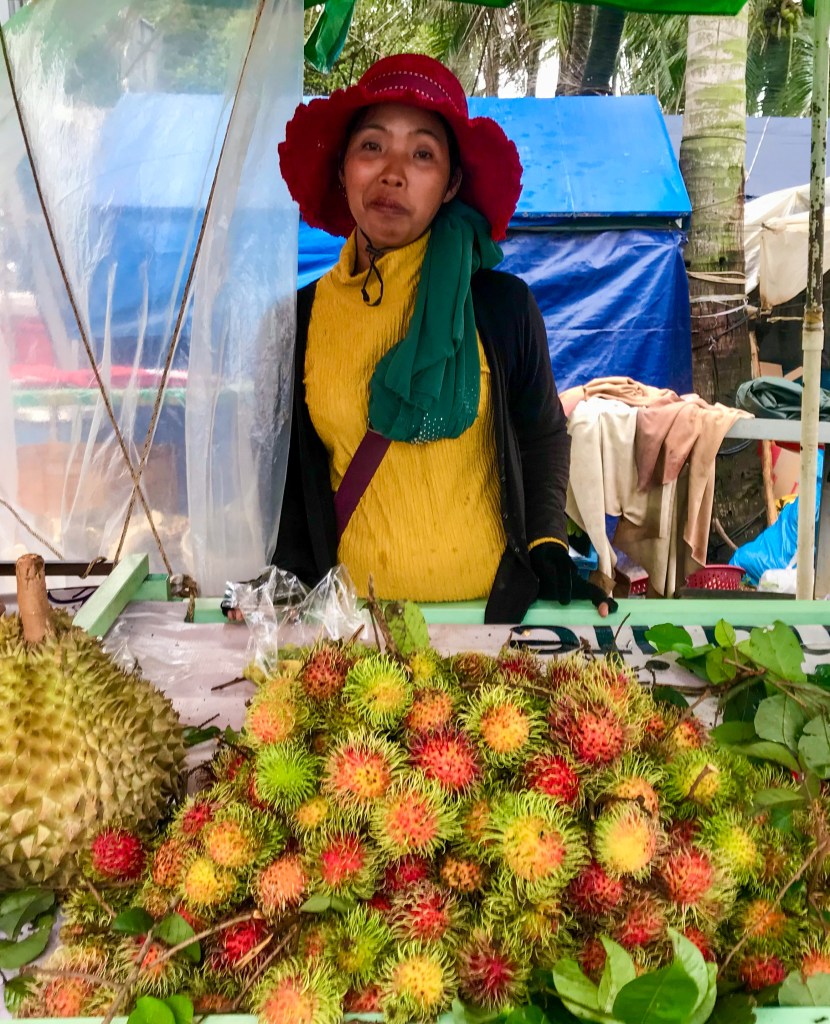
The crab market at Kep is famous throughout Cambodia. It’s not just fresh crab that’s sold here, of course; it’s all manner of seafood, from fish to shrimp, octopus, squid, skate and shellfish. Nearby, other merchants sold local fruit: It was clearly the season for rambutan and durian.
Island dreams
As I sucked the delicious meat from one claw after another, deftly avoiding bonelike shards of shell from sticking between my teeth (I mostly succeeded), I looked from my open-air table across the narrow beach to see a lofty island rising above the sea in the distance. This was Phu Quoc, an exquisite tropical resort island that is very much a part of Vietnam, but which actually lies closer to Cambodia.
I was fortunate to spend over a week on Phu Quoc in early 2021, a visit that I documented in blogs here and here. As the gull or tern fly, it’s only about 15 miles (24 km) to Phu Quoc from where I now sat. Currently, it takes a journey of over three hours from Kep, four hours from Kampot, by bus and ferry. But if a proposed speedboat shuttle service ever becomes a reality, the trip will require far less time … even if the land-sea border crossing is complicated by visa issues.

Spicy sojourn
Phu Quoc also has excellent seafood, as well as an acclaimed nước mắm (fish sauce) factory. But it doesn’t have Kampot peppers. As this spice is world-famous, why wouldn’t I be eating peppercorns with my pepper crab?
Here in the neighboring provinces of Kampot and Kep, in the quartz-rich soil at the foot of the 3,500-foot Elephant Mountains, pepper has been cultivated at least since the 13th Century — the halcyon days of the Angkor civilization. The slope provides perfect drainage for the kamchay (small leaf) and lampong (large leaf) vines, both of which may sprout long strands of green, black, white and red peppers, often from the same plant.
Plantation tours are a popular agritourism activity for visitors to Kampot. Tour guides show how the spice is planted, nurtured, harvested and eaten. It’s not alone, but I can recommend Paradise Gardens as one of the handful of farms that welcome visitors.
Should you require salt with your pepper, Kampot has that, too. Salt is harvested from shoreline mines and the sea itself, and spread on flat land to dry. You won’t miss the salt farms as you travel by tuk-tuk between Kampot and Kep, for example.
Colonial appeal
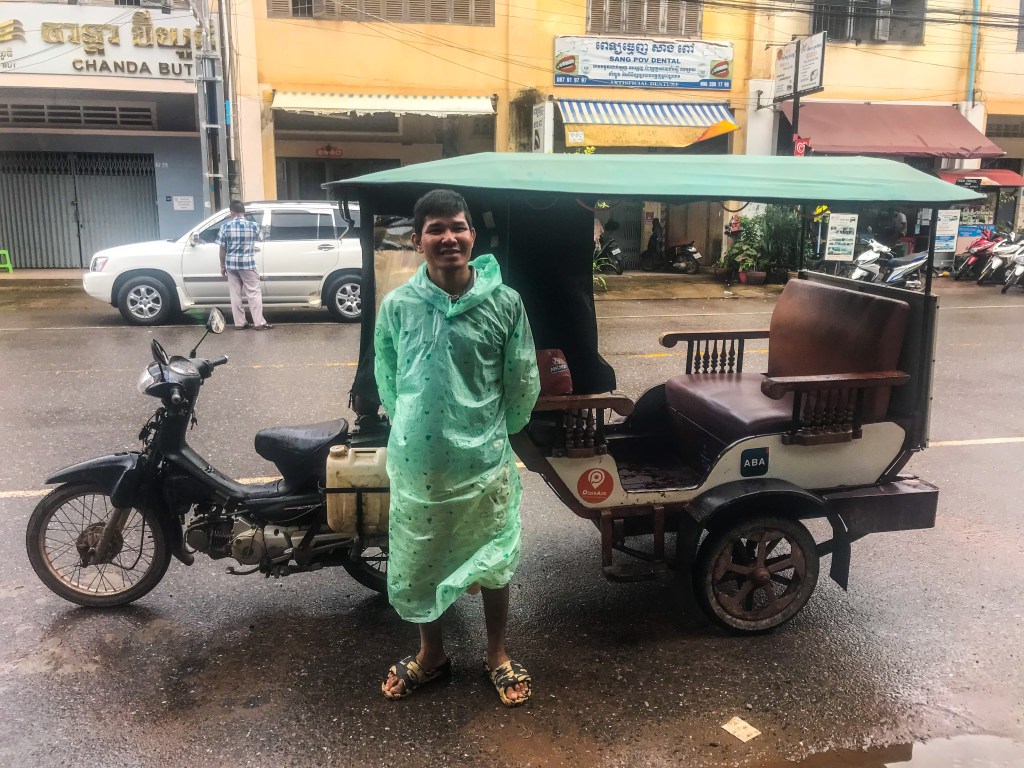
As throughout Cambodia and Thailand, tuk-tuk is the preferred form of local transportation in Kampot. There are plenty in service here, enough to get you through a couple of lazy days in Kampot, which is itself three hours (160km, or 100 miles) by express bus south of Phnom Penh.
Five km (3 miles) inland from the Gulf of Thailand on the wide and lazy Praek Tuek Chhu River, the former colonial market town itself is unremarkable, save for its well-preserved French architecture. For a brief time in the mid-19th Century, Kampot was Cambodia’s only international seaport. Atmospheric restaurants, bars and hotels look out upon the picturesque river; each end of its lone bridge is shaded by coconut palms.
The Old Market quarter was quiet at the time of my visit on the weekend of Cambodia’s national election — a “no-drinking” holiday loosely enforced to ensure that everyone went to the polls. Certainly, everyone who had cast their ballot had an inkpad-black index finger. (More than a couple of locals told me, though, that it didn’t really matter who they voted for. The same party has been in power for 38 years, and prime minister Hun Sen was simply planning to transfer his post to his son, Hun Manet.)
Between the girlie bars (closed for the holiday) and the excellent Indian restaurants (Simon’s Tandoor had the best navaratam korma I’ve found in Southeast Asia), I discovered an expat-owned new-and-used bookstore. I was delighted to snare the most recent “Jack Reacher” thriller: I had been unable to get it in Ho Chi Minh City!

Paradise found
Pending completion of a new highway to Kep, badly rutted red-dirt roads lead from town, past the pepper plantations and extensive rice fields, and through small villages. A couple of byways lead to Preah Monivong Bokor National Park, embracing a French hill station from the distant past, now abandoned and falling to ruin. Hikers can also enjoy caves, waterfalls and stunning mountain views. The forest is dense, the wildlife diverse (including bears, leopards, pangolins, macaques and gibbons) To the east there’s more panoramic hiking at Kep National Park. I’ll return with more time simply to go walking in the jungle.
I don’t often say this, but the highlight of my visit to Kampot was my accommodation. The unheralded Phoum Rumduol Bungalow was a little piece of heaven in a tranquil neighborhood just a couple of kilometers north of the night market. It’s quiet except for twice a day, when the Phnom Penh-to-Sihanoukville train comes through and stops across the street. But even the iron horse isn’t all that noisy.
Far from the noise of Saigon or even Phnom Penh, Phoum Rumduol was a true oasis. Although I was traveling alone, my private cabin (one of only nine) was extremely spacious, tastefully furnished and well-maintained. In the evening, I could sit on the porch and read or write. I was surrounded by a lush garden with orchids and a variety of other tropical flowers. I could enjoy a swimming pool and a tasty breakfast prepared by a genial English-speaking host. And best of all, during the rainy season, I paid just 64,000 Cambodian riel (US $16) a night.


 Travels in Vietnam