26. The Bleak Legacy of War

Ho Chi Minh City’s most profoundly emotional collection is displayed at its War Remnants Museum, where visitors learn more than they wanted about what is called the American War.

Deadly ordnance, some of it concealed long after the war, is displayed at the museum. (JGA photo)

Pham Anh Dao, 70, gestured toward his left foot, or what should have been his left foot. Now, there was merely a knob, a long-ago memory of a field medic’s emergency handiwork. The American War had already ended, Dao told me, when he stepped on a land mine in the jungles of Vietnam’s Central Highlands. He was lucky. He survived.

Dao’s story is hardly unique. The war that the United States waged in Southeast Asia between 1965 and 1975 took a terrible toll. Yes, more than 47,000 Americans died; but so did over 1.5 million Vietnamese, including at least 350,000 civilians. (Casualty figures are estimates.) And those are only the dead.

In most of the rest of the world, it is not widely recognized that this is a war that has kept on giving — or, more accurately, kept on taking away. (Known in the U.S. as the Vietnam War, it is the American War in Vietnam.) The conflict left a legacy of unexploded ordnance as well as hereditary illness and birth defects caused by Agent Orange and other chemical defoliants.

The entrance to the War Remnants Museum on Vo Van Tan street. (JGA photo)

A Day at the Museum

For me, that’s the biggest takeaway from a visit to the War Remnants Museum in Ho Chi Minh City. (Another War Remnants Museum is in Hanoi.) I consider it the single most important urban attraction for Western tourists.

Located just a couple of streets north of Independence Palace, where South Vietnam surrendered to North Vietnam in 1975, the Ho Chi Minh City museum is a rude reminder to Western visitors that the Americans didn’t play nice. During a war, of course, no one plays nice, and the account rendered here is an undeniably biased one. But it’s hard to look at graphic photographs of atrocities like the notorious My Lai massacre or the Agent Orange attacks, whose victims still haunt Vietnam’s streets.

A father tells his children tales of the American War that he heard from his own father. (JGA photo)

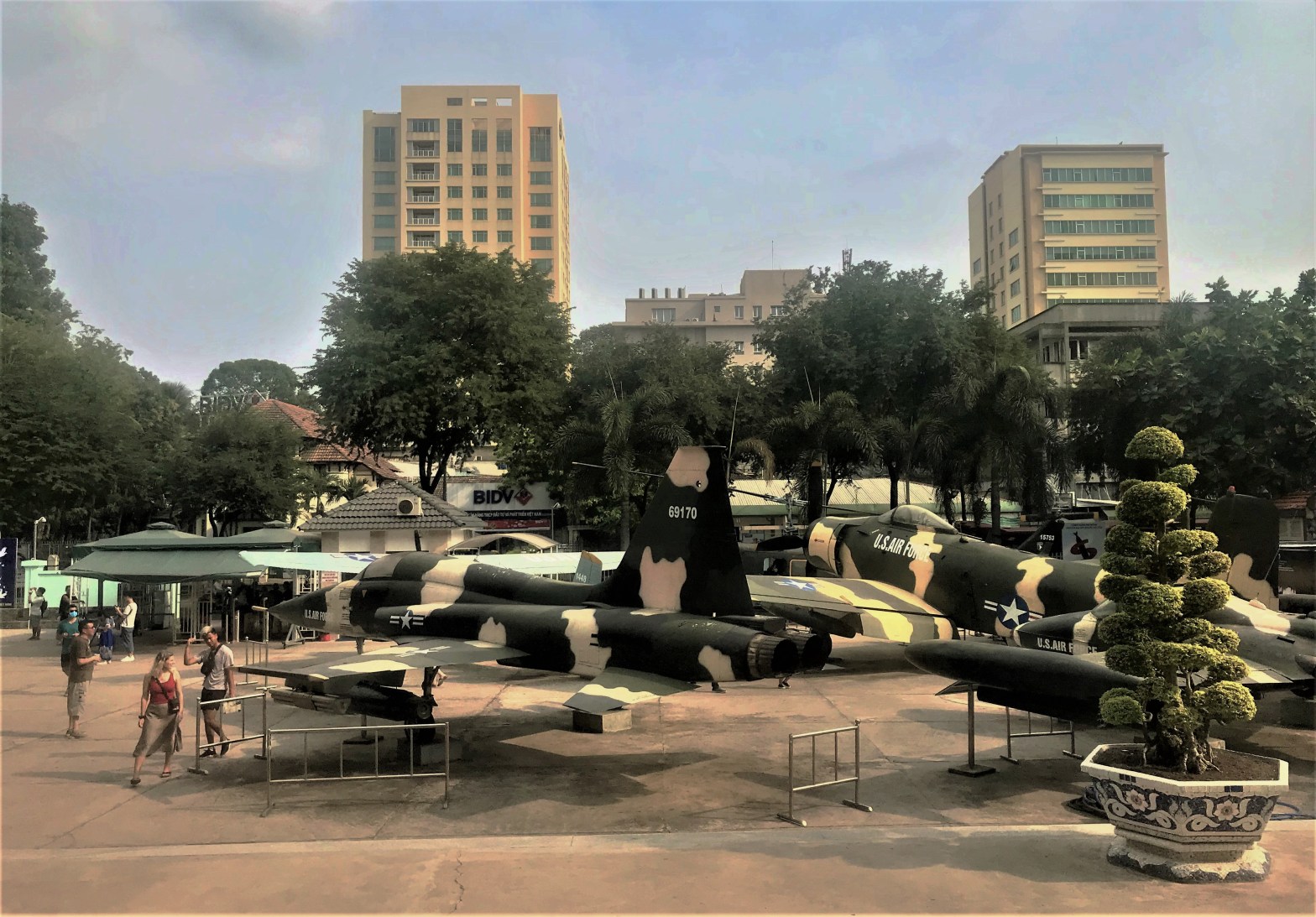
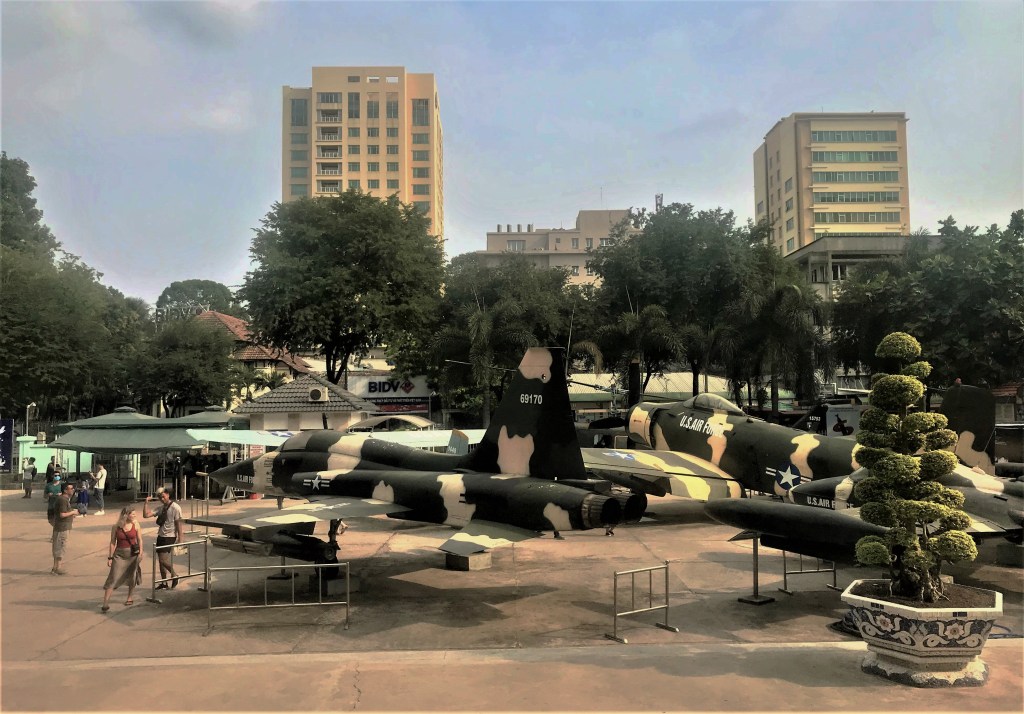
Visitors arrive at the museum through a curated display of captured U.S. tanks, warplanes and artillery (including an M132 flamethrower) in the museum yard, presented side-by-side with Vietnamese equipment. Nearby, a replica prison recalls such punishments as a notorious isolation chamber (the “tiger cage”) and a guillotine from the French colonial era.

War Crimes and Chemicals

Exhibits within the museum are on three floors, with interpretive signs in English, French and Vietnamese. On the ground floor are well-documented testimonies by U.S. servicemen who could not keep silent about war atrocities after they returned home.

One level up, some of the frightening images that illustrate “War Crimes” may be all too familiar to older Americans who recall the carnage of My Lai, Son My and Pleiku. A collection of U.S. Army weapons is displayed for its role in the “persecution, torture, murder and massacre; bombing innocent peoples’ homes, villages, hospitals, schools, causing casualty and damage to Vietnamese people.”

A museum visitor perceives the pain of a young Agent Orange victim in a gallery painting. (JGA photo)

Other rooms on the same floor describe, in words and pictures, the disabling efffects of Agent Orange and related dioxins. Panels of photographs looked like something from a freak show. As many as 3 million Vietnamese suffered disfiguring wounds or illnesses as a result of exposure to the chemicals. Third and even fourth generations of victims still show genetic disabilities; the International Red Cross estimates that as many as 1 million people may still have health problems as a result of the dumping of Agent Orange prior to 1975.

Historical Truths

On the top floor of the museum, an informative display labeled “Historical Truths” lays out the roots of the American War, beginning with communist Vietnam’s 1945 declaration of independence from colonial France and its subsequent war with the Europeans. That ended with a final victory in 1954 at Dien Bien Phu, on the border of Laos in North Vietnam. The U.S. almost immediately involved itself by providing financial aid and military advisers to the democratic government of South Vietnam. The Americans crossed the thin red line when Marines landed at Da Nang in 1965. The next 10 years were ugly.
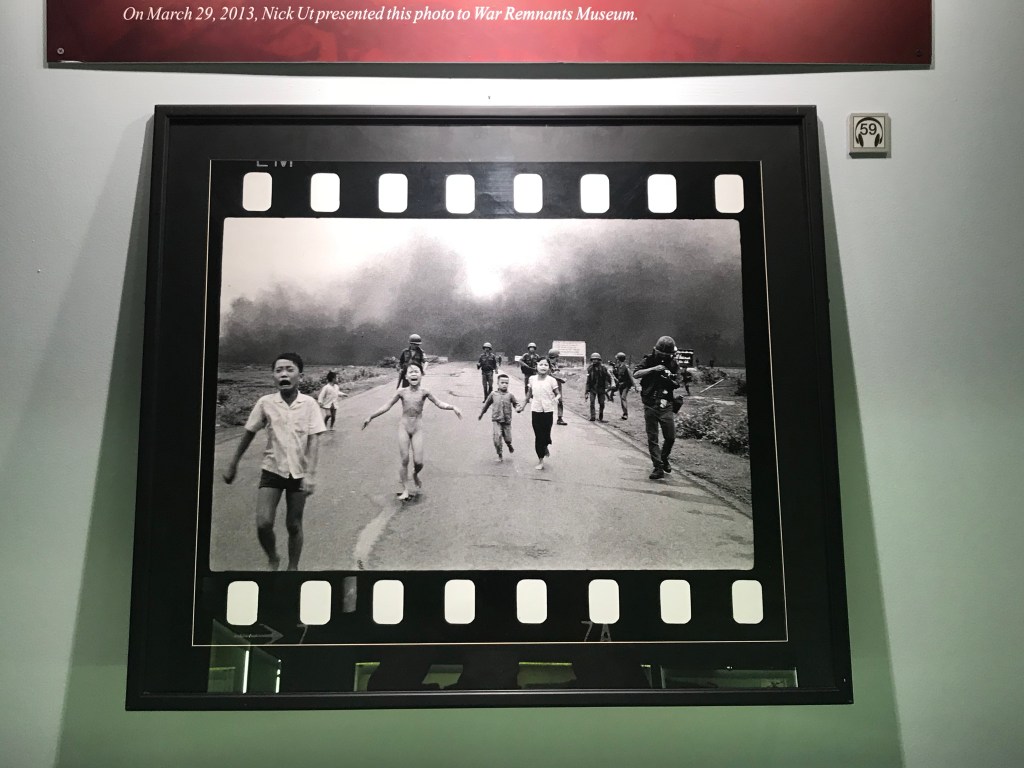
This famous 1972 image shows Vietnamese children fleeing a napalm attack in Trang Bang village. (Nick Ut photo by JGA)

In “Requiem,” I found a collection of more than 200 photos by (and of) 133 war correspondents from 11 countries who died doing their jobs in Vietnam. As a journalist myself, I found this particularly poignant. Indeed, in my earliest years in the business, in the early 1970s, I had brief conversations with a couple of the men pictured here. Journalist Carl Robinson, who lived in South Vietnam from 1964 to 1975, is a personal friend.

Unexploded Ordnance

An exhibit on unexploded ordnance brought me back to my conversation with Pham Anh Dao. Since the war ended 46 years ago, the detonation of land mines, bombs, mortars and grenades has killed more than 40,000 people in Vietnam and adjacent Cambodia and Laos. The ordnance still takes several hundred lives a year — often innocent people planting rice or tilling their gardens.

Gratefully, the U.S. government has spent more than $65 million in the past 20-plus years to clear ordnance, and nonprofit organizations like Seattle-based PeaceTrees Vietnam have done their part. But rural areas, especially the central provinces, may remain hazardous for many more decades. I’ll be especially cautious when I wander from the beaten path, lest I suffer an injury like my friend Dao … or worse.

As many as 500 unarmed civilians may have died in the 1968 massacre at My Lai. (Ronald l. Haeberle photo)
Campus of Ho Chi Minh City’s War Remnants Museum. (JGA photo)

Next: A visit to Phu Quoc island
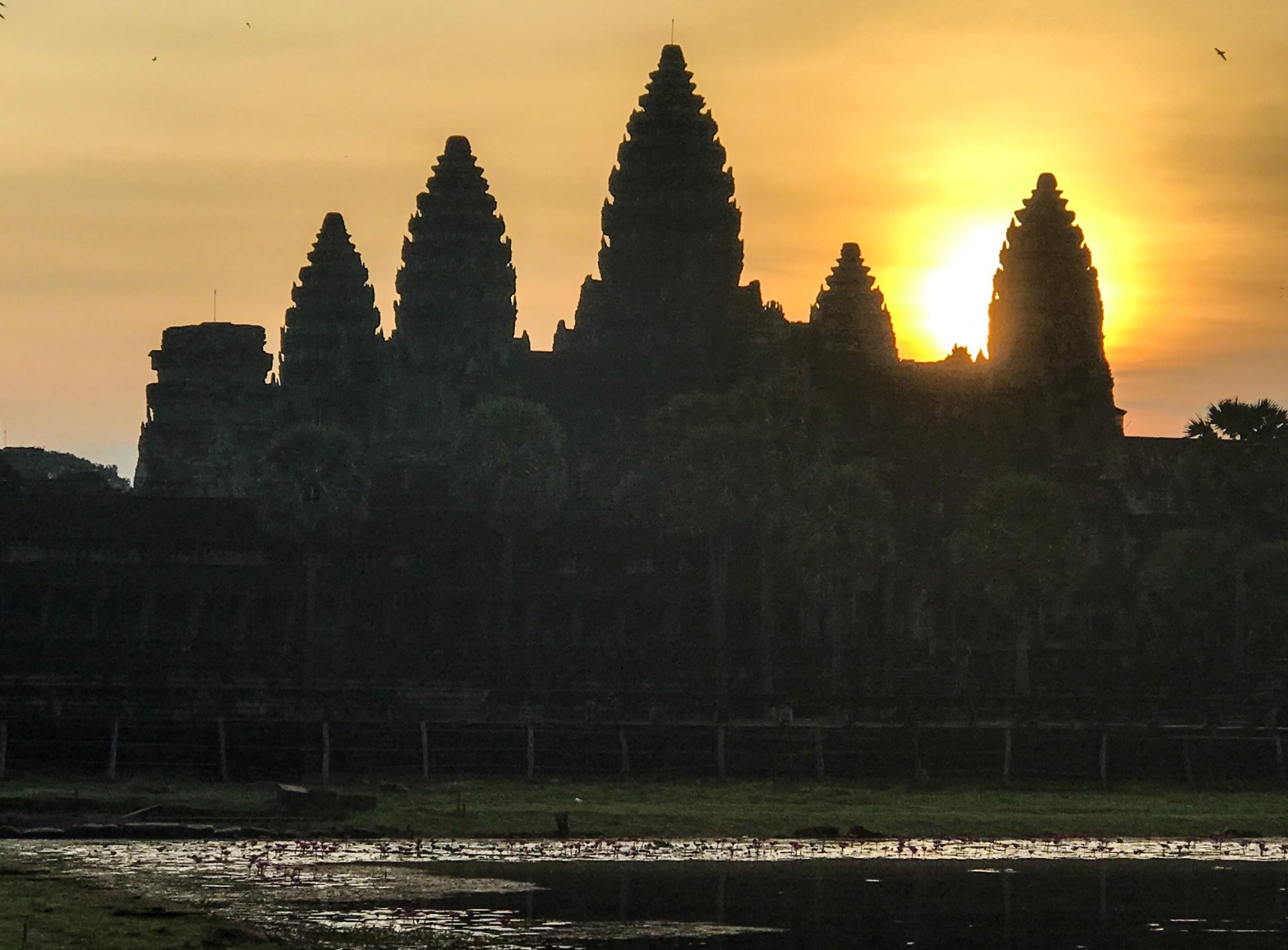
Book Review: Angkor in Modern Cambodia

Children at Angkor, photo by book author John Burgess, 1980

My review of John Burgess’ new book, Angkor’s Temple in the Modern Era, has been published by the East-West News Service. Please also see my 2023 story on Angkor.

Angkor Wat: Cambodia’s 9th century temple complex fights to preserve its past | East-West News Service

25. Tay Ninh and the Cao Dai Religion

The Cao Dai faith is an otherworldly blend of Asian, European and mystical beliefs. Its mother temple is a mere 80 kilometers from Ho Chi Minh City.

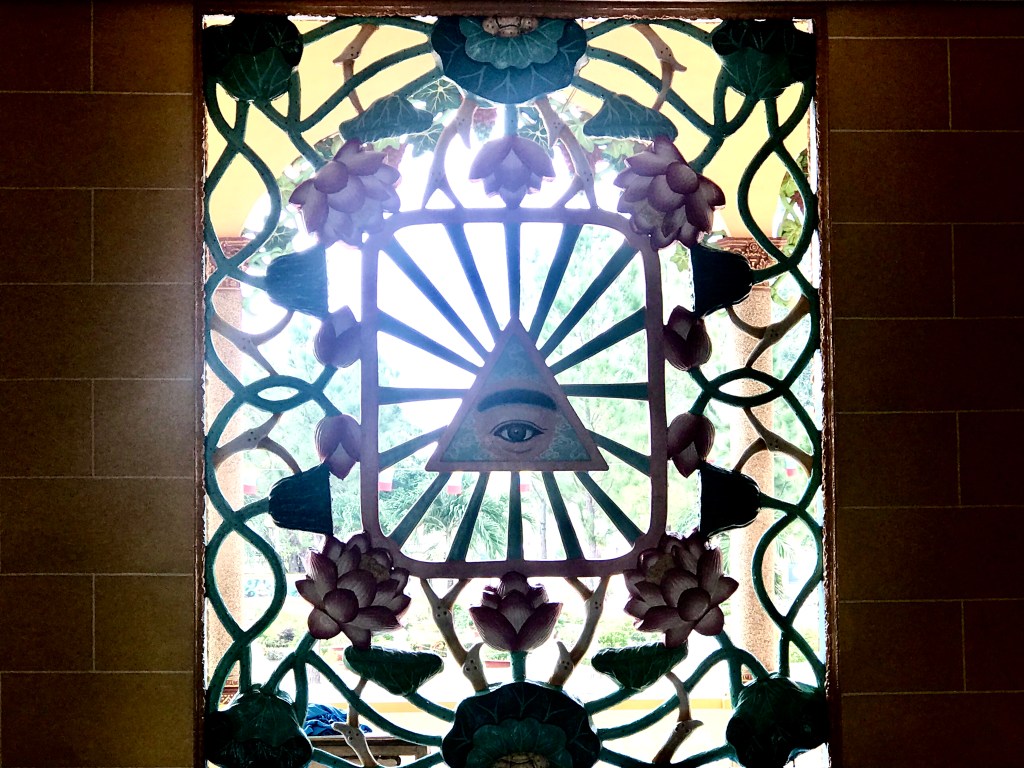
God is watching you everywhere at the Cao Dai mother temple in Tay Ninh. (JGA photo)

You know The Eye?

Yeah, that one. The Eye of Providence. The one in the pyramid on the Great Seal of the United States. The eye whose gleam illumines obscure Latin mottos on the back side of the dollar bill. The all-seeing Eye of God embraced by Knights Templar, Freemasons and Rosicrucians alike.

Everywhere I went in the mother temple of the unique Cao Đài faith, in the provincial capital of Tây Ninh, it was watching me. Or so it seemed. And I continued to imagine The Eye long after I left.

It appeared in every doorway and window, framed by the holy trinity of a perfect triangle, rays of imaginary sunlight reaching beyond its universe. And it was embedded in a giant, globe-like orb, luminescent blue and green like Earth itself, elevated on a dais where another church might have placed an altar.

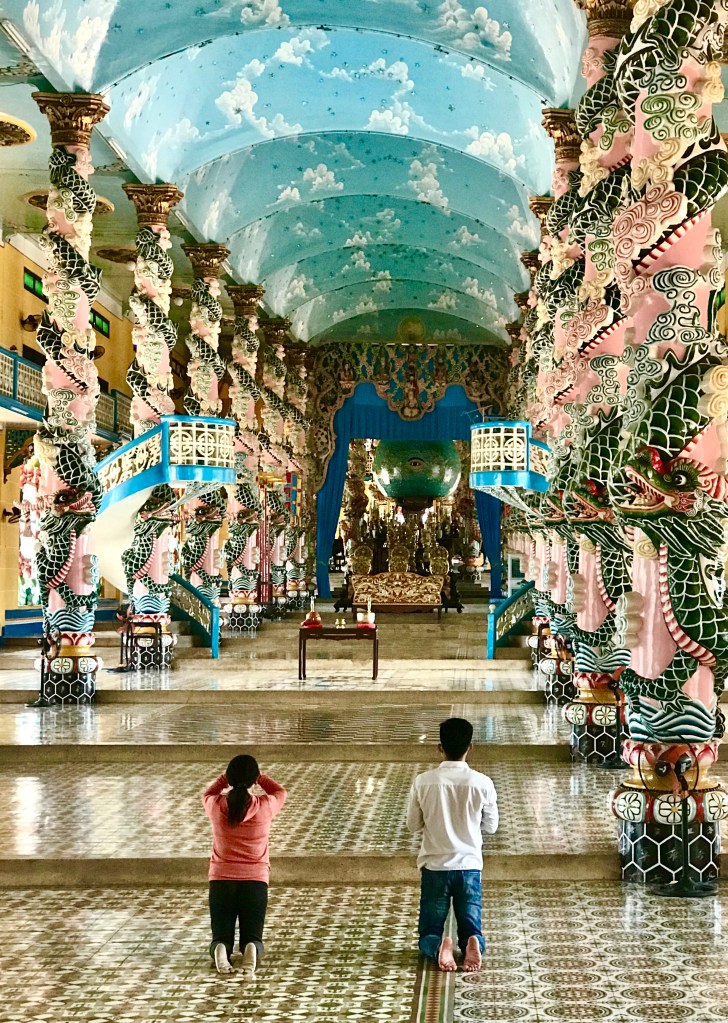
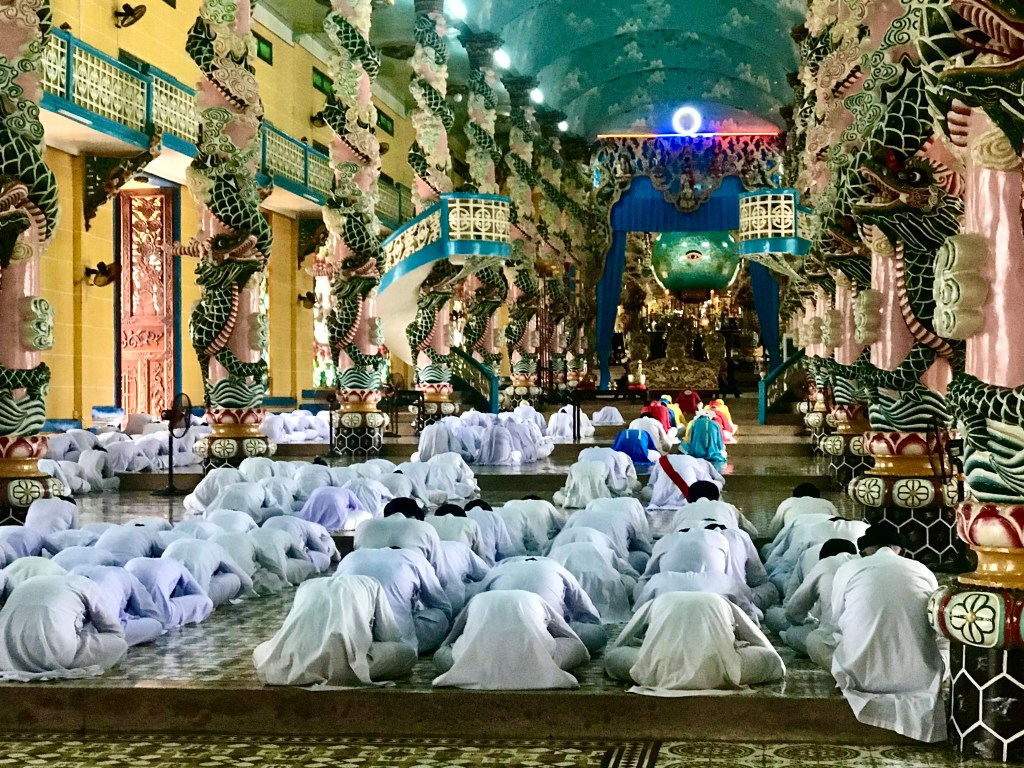
During holy hours, you may see scores of Cao Dai devotees, cloaked in white and wearing black hats, singing and chanting and bowing in unison to this “left eye of God.” To me it suggested an old Flash Gordon sci-fi movie, or perhaps an Indiana Jonestown parody.

Every window and doorway has, at its core, the Cao Dai eye. (JGA photo)

East meets West

I hadn’t expected to see this sort of ceremony in Vietnam. As a student of world religions, I had anticipated a largely Buddhist society, with significant numbers of Catholics (a French colonial legacy), Chinese Taoists and Confucians. And in a communist society, I expected that many would profess to “no religion.” I didn’t think I’d find the whole mix in a single package.

Although it has an estimated 3 to 5 million followers worldwide (mostly in Vietnam), I had never heard of Caodaism. Founded by Vietnamese spirit mediums in the 1920s, the religion merges 19th-century European mysticism with the various East Asian faiths.

Its objectives are honorable — the unity of all religions; the harmonious balance of the universe; the coupling of god and mankind, love and justice (and karma).  The two main gods, Cao Đài (“Highest Power”) and Diêu Trì Kim Mẫu (the Mother Goddess), are considered equal creators of the universe, the yin and yang of humanity. If there ever was a duotheistic religion, this is it.

But here in Tây Ninh, 50 miles (80 kilometers) northwest of Ho Chi Minh City, it seemed a little cosmic, a little spooky, to have the “left eye” of the all-seeing Cao Dai watching me as I moved through the massive Great Temple of the Holy See.

Cao Dai devotees offer prayers in the nave between services. (JGA photo)

Four services daily

Prayers are offered daily at noon, 6 p.m., midnight and 6 a.m. Men, having removed their shoes, enter on the right side of the sanctuary and move around the floor in a counter-clockwise direction. Women enter on the left and move clockwise. The area in the center is reserved for priests. During the full moon and new moon — the first and 15th day of each lunar month — the sanctuary welcomes a couple of hundred visitors. At other times, there may be only a few dozen.

I was glad to tour between services, when I could be ushered about by congregation members proud to share their beautiful house of worship. Red, gold and sky-blue dominate the color scheme. Mythological dragons and cranes wrap themselves around gaudy columns. Fanciful carp spout upward, dreaming that they, too, might someday be dragons.

On another level are altars for worship of ancestors, much as one might see in a Confucian or Taoist temple.  An adjacent building has meeting rooms and a kitchen and dining area. Caodaists, who practice vegetarianism, earn good juju when they work in the kitchen to feed others. That includes substantial charity work.

Sun Yat-sen, left, and Victor Hugo, center, are among the most revered figures of the Cao Dai faith. (JGA photo)

Cosmic truths

The avatars of the Cao Dai faith are not whom you might expect. For one, there’s Victor Hugo, the 19th-century French author of “Les Misérables.” He has been assigned the post-mortem post of “spiritual chief of the foreign missions of Caodaism.”

Along with early 20th-century Chinese patriot Sun Yat-sen and medieval Vietnamese poet Nguyen Binh Khiem, Hugo is a “signatory of the Third Alliance Between God and Man,” although the trio lived their earthly lives at different times. They are said to be guiding humanity into a new era of enlightenment, ably assisted by Joan of Arc, Louis Pasteur, William Shakespeare and Vladimir Lenin, to name but a few.

Throughout history, according to the faith’s leaders, Cao Đài has communicated his cosmic truths through a series of prophets — great visionaries like the Sakyamuni Buddha, Taoism’s Lao Tzu and Jesus Christ. But mankind has not embraced their messages, distracted by physical and secular desires. The time has finally come, Caodaists believe, when God is speaking directly to humanity instead of through a messenger.

As a covenant between Heaven and Earth, the objective of the Third Alliance is universal peace. It will be ushered in by a period of intense religious activity that “will unite God and humanity in ways not yet imagined,” a church leader told me.

But it’s imperative that we listen. If we ignore the truth one more time, things could get really ugly. The choice is salvation for living beings … or universal destruction. And none of us really wants that.

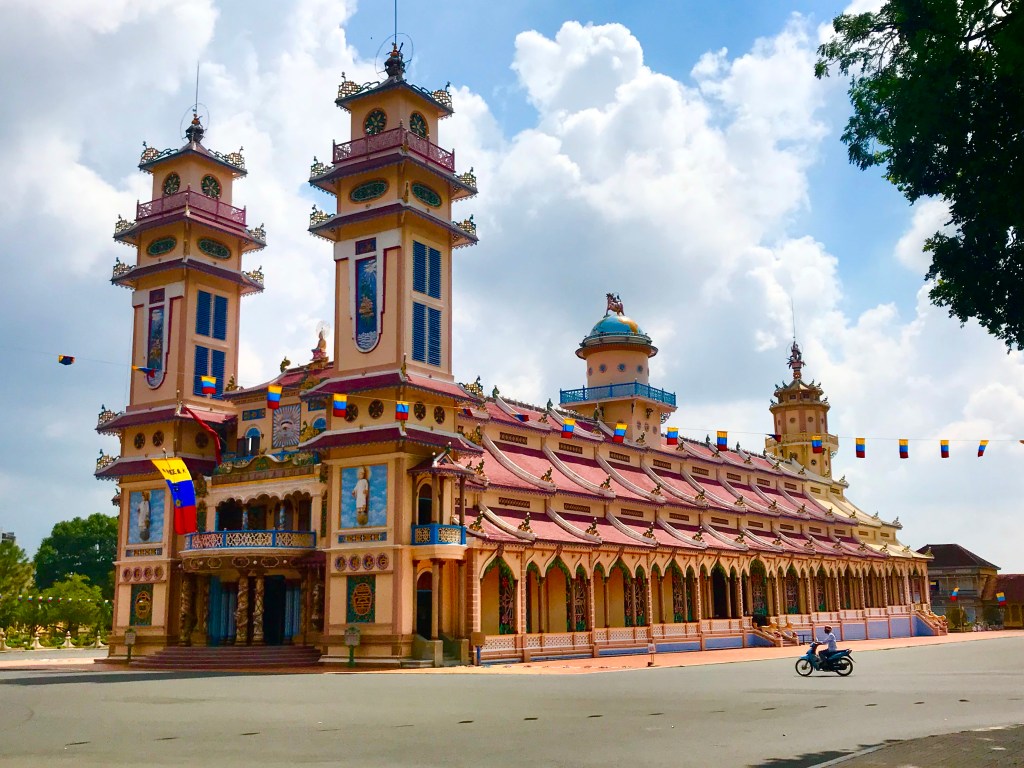
The Great Temple of Caodaism is a prominent structure in Tay Ninh. (JGA photo)

Cao Dai community

The Cao Dai temple is the main feature of the township of Hoa Thanh, located about 4 kilometers from the heart of Tây Ninh. Started in 1931 and completed in 1947, the temple sets the tone for other Cao Dai sanctuaries in Vietnam with a blend of ornate architectural styles as staggeringly dissimilar as the religion’s doctrines.

The building is 320 feet long, with 156 pillars and two tall towers at its front. Adjacent avenues are fronted by administrative buildings, public gardens, a hospital of traditional herbal medicine, large schools, lovely homes and other structures that suggest substantial wealth in this community.

Tiers of grandstands flank the boulevard that approaches the temple from the elaborate main gate, providing viewing for occasional festival parades and funeral processions. Most times, however, they are playgrounds for about 150 macaque monkeys who live in the adjacent forest. The younger generation of these primates can provide considerable entertainment for visitors, but they can also be a nuisance for the unwary.

A cablecar carries visitors through the clouds to the summit of Ba Den Mountain. (JGA photo)

Ba Den Mountain

Tây Ninh itself is a lovely town of about 150,000 people, with broad streets and precious little traffic, especially compared to Ho Chi Minh City. Apart from the Cao Dai community, its main appeal for visitors is Ba Den (“Black Virgin”) Mountain, with views into neighboring Cambodia from 10 km northeast of the urban center.

The solitary cinder cone, largest free-standing peak in southern Vietnam, rises to an elevation of 986 meters (3,235 feet) above surrounding rubber plantations and fields of rice and corn. Those who follow a strenuous trail to the crest can enjoy a respite at a tranquil Buddhist temple complex halfway up the mountain, and several ancient cave temples near the summit.

The vast majority of visitors avoid the walk and take a cablecar to a visitor center on the mountaintop. Many of them are young families, dating couples and honeymooners. The destination’s popularity has mushroomed to the point that SunWorld, a national hospitality group, is completing a hotel on the peak’s highest point. The structure is so prominent that, from many miles away, it looks like Ba Den’s nipple.

The summit of Ba Den Mountain is a popular location for wedding photography. (JGA photo)

For anyone planning a visit to Tây Ninh, I recommend the understated Gold City Hotel , a modern boutique property on a quiet downtown street. The hosts are exceptionally generous with their time and in providing assistance, and there are numerous choices of restaurants — and a great little pub — in the immediate neighborhood.

Worshippers kowtow to the Cao Dai eye during a midday service in Tay Ninh. (JGA photo)

Next: the War Remnants Museum

24. Celebrating Tét

Vietnam’s biggest annual holiday celebration is Tet, the lunar new year. It’s kind of like Thanksgiving, Christmas and New Year’s Day rolled into one.

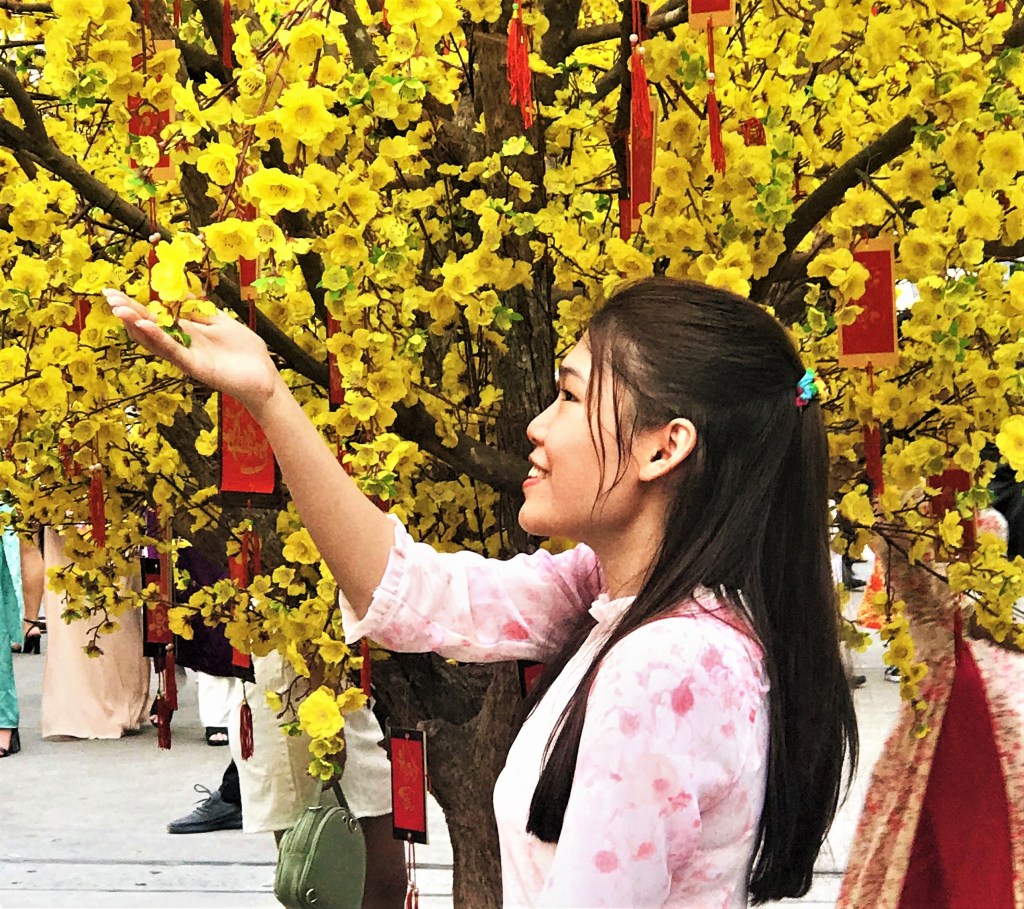
Apricot blossoms on Dường Nguyễn Thị Minh Khai (JGA photo)

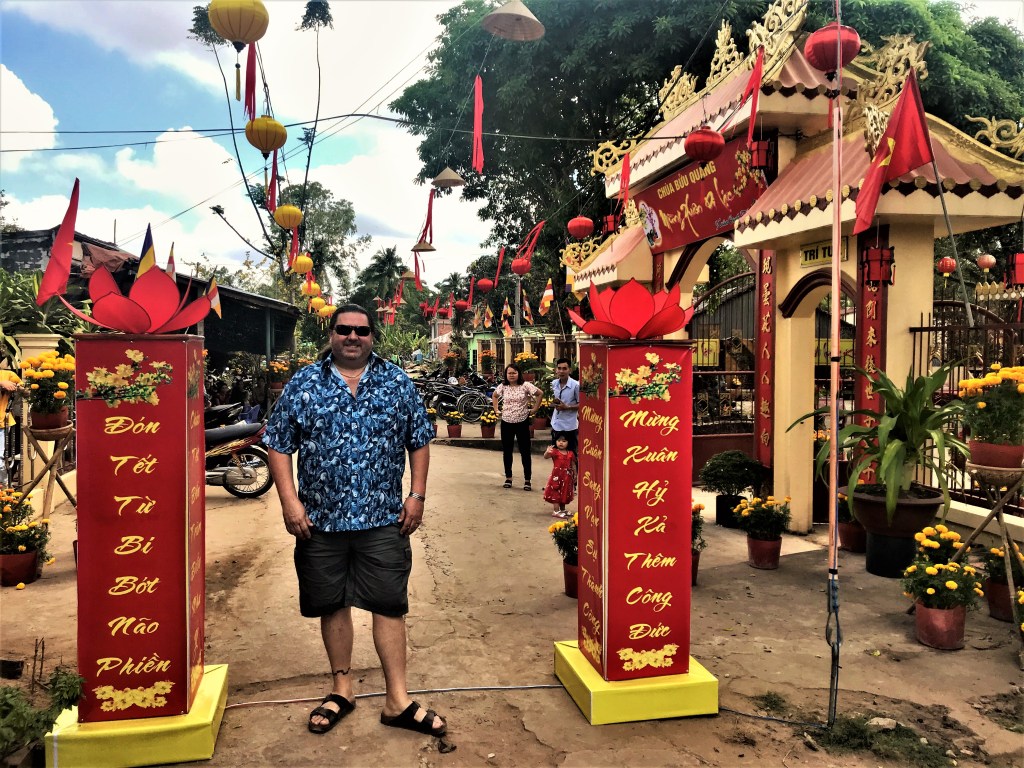
It’s that time of year again! Chúc mừng năm mới!

In Vietnam, the Tết holiday, which technically begins today, is equivalent to Thanksgiving, Christmas and New Year’s Day all rolled into one.

The Vietnamese people don’t get a lot of long vacations. They work hard for 50 weeks, often putting in seven days a week on two jobs. Tết — the lunar new year — is the one time they can truly “cut loose.” (This is evident if you track the bulge in November births.) During Tết, employees get at least five days off from work, more to bridge weekends, and it’s not uncommon for companies to stretch the break to a couple of weeks.

Tết is the word for festival. In this context, it is short for Tết Nguyên Đán, which means “Feast of the First Morning of the First Day.”  It falls on the first night of the new moon in the first month of the Lunar (Gregorian) Calendar, between late January and mid-February. In 2024, the new year will fall on Saturday, February 10. [in 2023, it was January 22.]

Workers prepare the opening of ‘Flower Street” on Nguyen Hue (JGA photo0

Flowers and food

Besides marking the beginning of the year, Tết signals the first day of spring … and the day when everyone becomes one year older. In Vietnamese tradition, age is determined by the new year and not by the actual date of birth. Perhaps not coincidentally, one of the first questions asked upon an initial meeting in Vietnam is: “How old are you?”

You may then be asked: “What is your hometown?” A huge number of the younger (and middle-aged) people living in the major cities today maintain strong ties with the provincial towns where they, or their parents, were born. During Tết, their exodus from Ha Noi or Ho Chi Minh City, to be with hometown family and friends, has an indelible impact on the population centers. Restaurants and other businesses close down, transport services are stretched to the limit, and the cities seem like ghost towns.

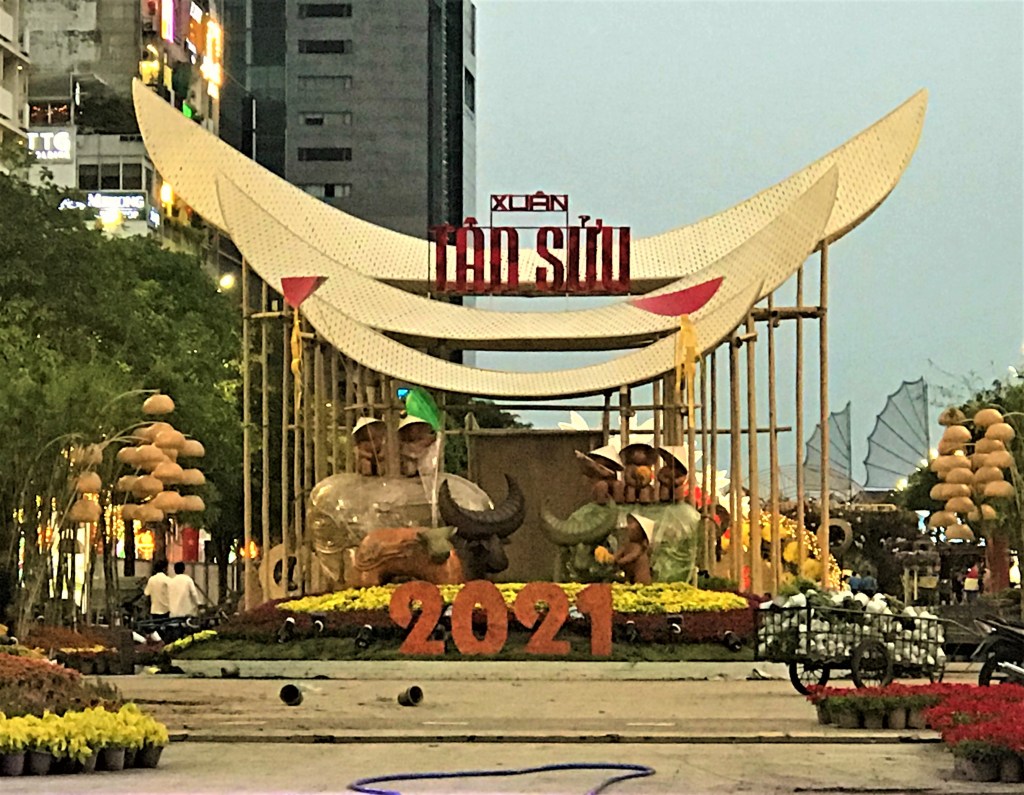
A family of water buffalo greet the new year outside the Diamond department store (JGA photo)

At least in HCMC, the city-center boulevard, Nguyễn Hue, stays lively through the week of Tết. This broad pedestrian street becomes “Flower Street,” which in recent non-pandemic years has attracted more than a million visitors. Yellow apricot blossoms and light-red peach blossoms, representing good fortune, are ubiquitous, as are the tiny orange fruits of the bonsai-sized kumquat tree. Among the trees and flowers are various depictions of the animal of the new year — in 2021, it’s the water buffalo (or bull); in 2020, it was the rat.

Adjacent streets have community fairs. On Dường Nguyễn Thị Minh Khai in District 1, for instance, music, art and calligraphy mix with popular street foods. Inevitably you’ll be offered “chung cake” (bánh chung or banh tet), made of sweet sticky rice, corn or green beans, pork and spices, wrapped in a leaf and boiled overnight. Legend traces its origin back more than 2,000 years.

“Chung cake,” or banh tet, is made from sticky rice, pork and vegetables. (JGA photo)

A fresh start

The lunar new year festival traditionally lasts for three days. It is considered a time to begin anew — to let go of the problems of the past year and start all over. People pay off old debts. They buy new clothes and often change jobs or switch careers. During the last week of the old year, they sweep away all the bad things that have accumulated in the previous 12 months with a thorough cleaning of their homes and gardens, especially including altars that honor gods and ancestors.

Traditional holds that on the eve of Tết, Ong Tao, the “kitchen god,” travels to the heavenly home of the Jade Emperor to give his annual report on family members. He is hastened on his way by carp, released into rivers as vehicles of the divine. These fish become dragons at midnight on the new year, when Ong Tao returns and is welcomed back with fireworks and gongs.

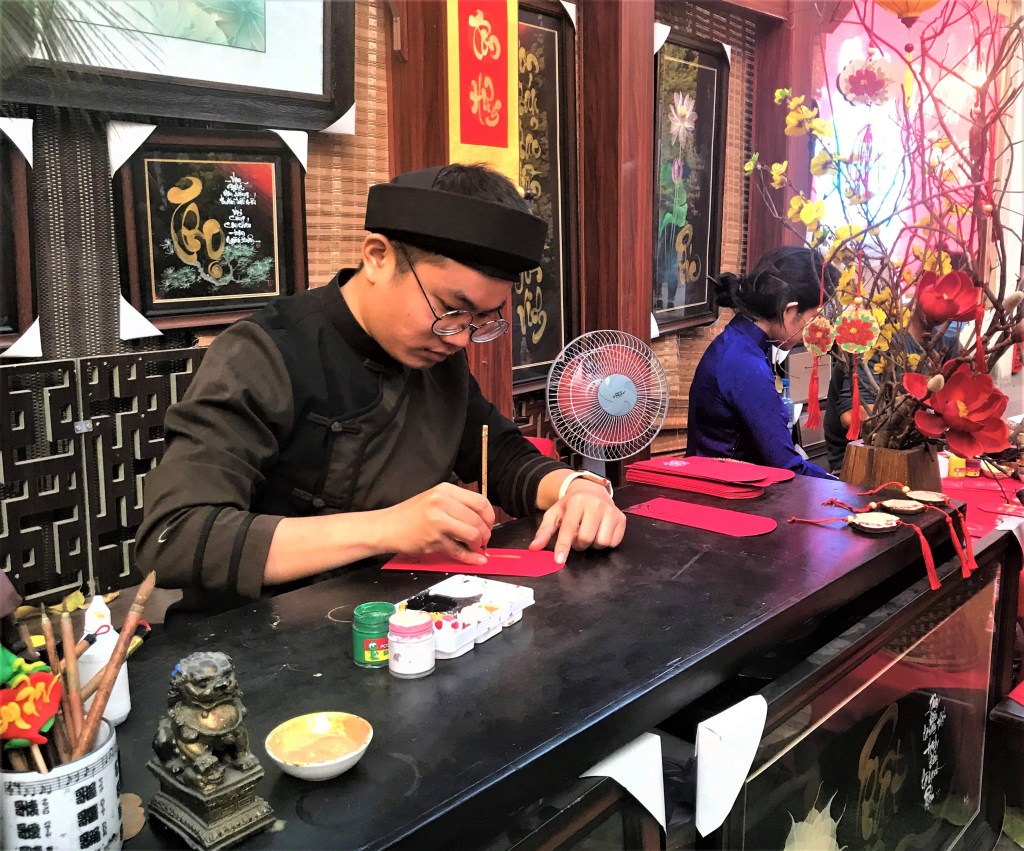
Calligraphers and fortune tellers forecast the future at street fairs. (JGA photo)

While Ong Tao is away, the multigenerational family feasts. Everyone avoids bad thoughts or arguments in case they allow bad spirits into the house. When younger people go out to watch the fireworks, their parents and grandparents offer pig heads, boiled chicken, rice and salt to the gods and ancestors. They will pray for a new year of luck, health and fortune to every family member.  After midnight, the young people return home and become the first to enter the house in the new year, bringing luck to the family.

The first day of the new year is the time to visit grandparents and relatives. They gather again to drink, eat and share their wishes and plans. Children are given lucky money inside red envelopes, which may keep children away from evil. The elderly receive gifts and wishes for health; younger adults receive tokens of fortune and success.

Ancestral altars get special offerings on the new year. (JGA photo)

By the third day of the Tết holiday — Day Two of the new year — people go to pagodas and pray for a year of prosperity, happiness and health. Their donations are repaid with assurances of luck and fortune.

These are some of the greetings you may hear this week:

An khang thịnh vượng: Wishing you safety, health and prosperity.

Vạn sự như ý: May all your wishes come true.

And, of course, Chúc mừng năm mới. Happy new year.

Celebrants welcomed the year of the rat in January 2020. (JGA photo)

Next: Tay Ninh and the Cao Dai religion

23. Mugged

Getting mugged in any city is no laughing matter. It may only be about money, but after it happens, will you ever feel safe again?

These are valuables that no traveler ever wants to lose. (JGA photo)

No matter where in the world you might go, crime is real.

I’ve been fortunate. Except for bullying as a nerdish youth, a couple of minor cases of home burglary, and occasional petty theft like pickpocketing, I have never really been a victim.

Now I have been.

It only happened once, about six months ago. But it served as a reminder that — mentally strong though I believe myself to be — we all have a place of vulnerability, an Achilles heel. Mine, it can be reasonably argued, is the simple awareness of how easily my trust and innocence can be shattered.

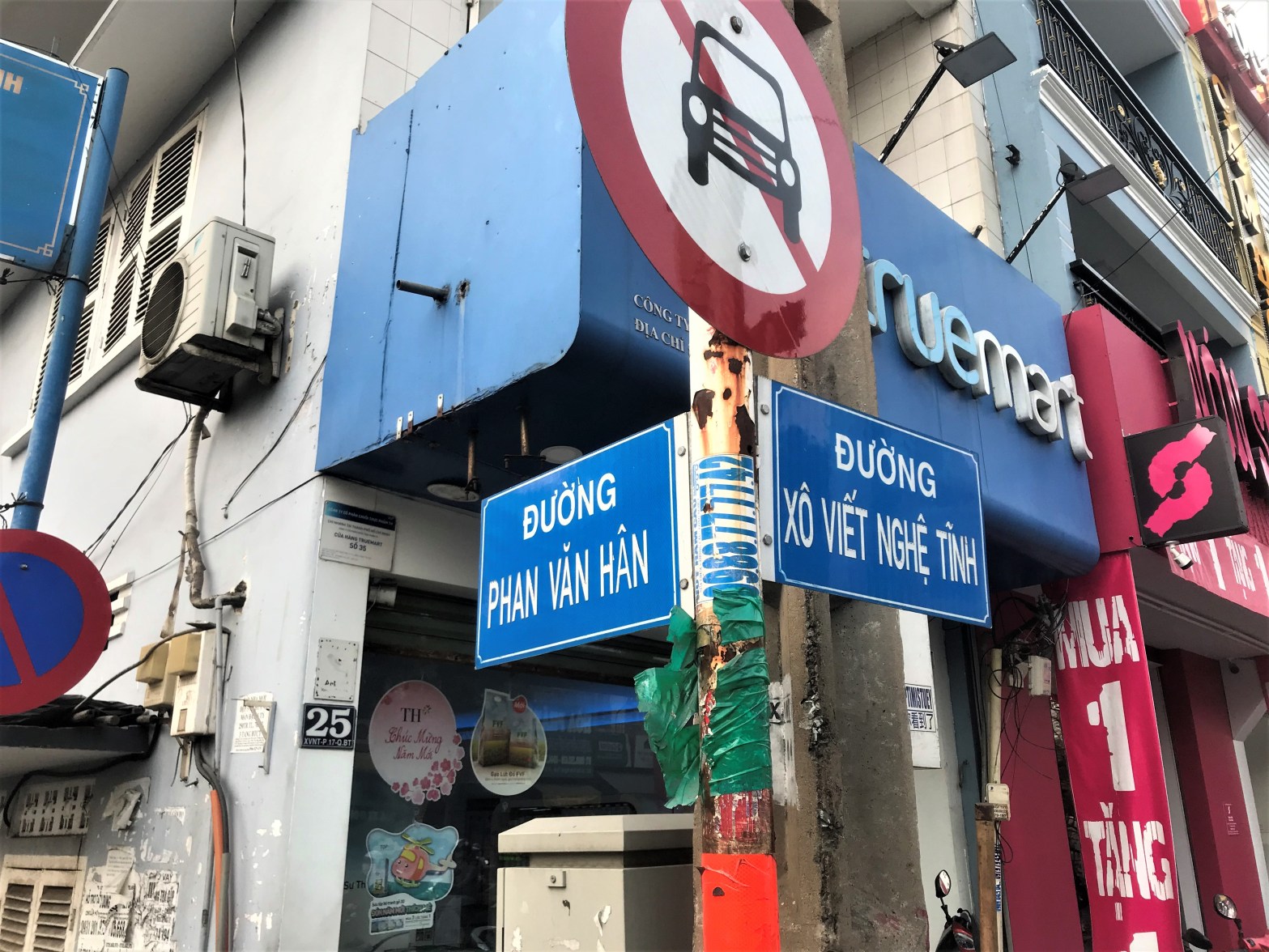
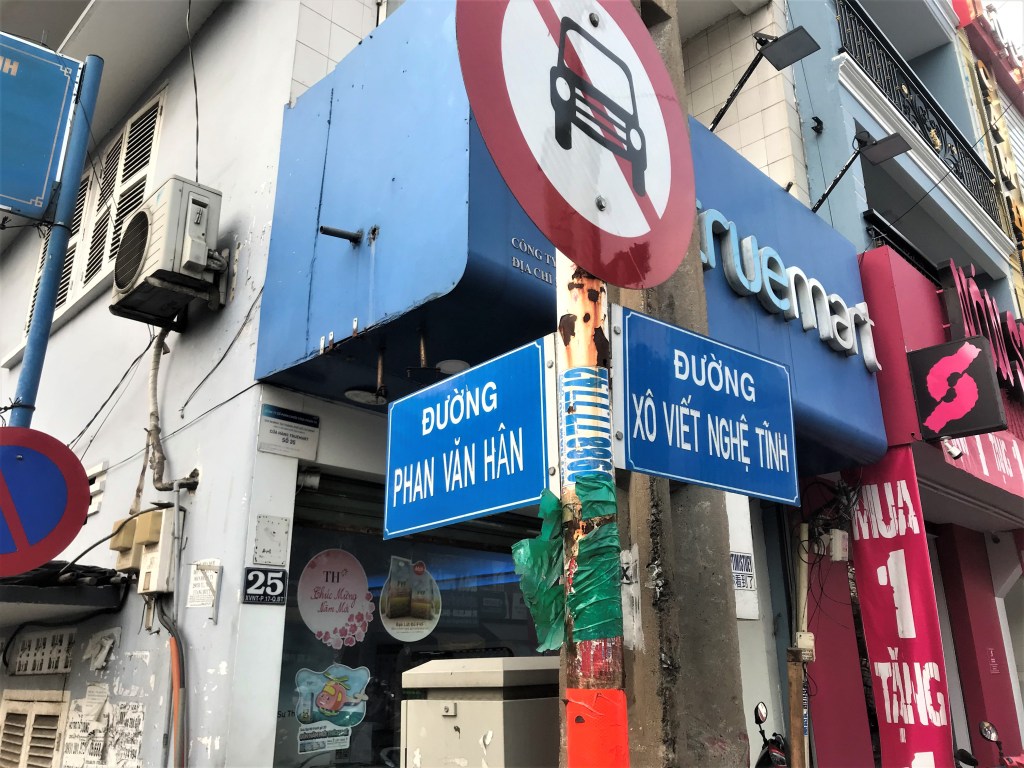
Phan Van Han, a narrow market street, was the location of the crime. (JGA photo)

Broad daylight

I was mugged in broad daylight on a Friday afternoon, as I walked a kilometer home from the Naman import grocery store in Da Kao. With my day pack full of Australian beef and Swiss muesli, French cheese and Chilean wine, I navigated the construction sites along Nguyen Thi Minh Kai street and crossed the bridge over the Thi Nghé Channel. From here, I looked down at bamboo-roofed sampans floating past neglected double-deck tour boats, moored beside a riverside café as they have been since the COVID epidemic was spawned a year ago.

The footpath came to an end at a steep curb, where motorbikes merged perilously into bridge traffic. Here I turned sharply left onto Phan Van Han street. This narrow market lane is shared by motorcycles and a rare truck or automobile, any single one of which is a severe impediment.

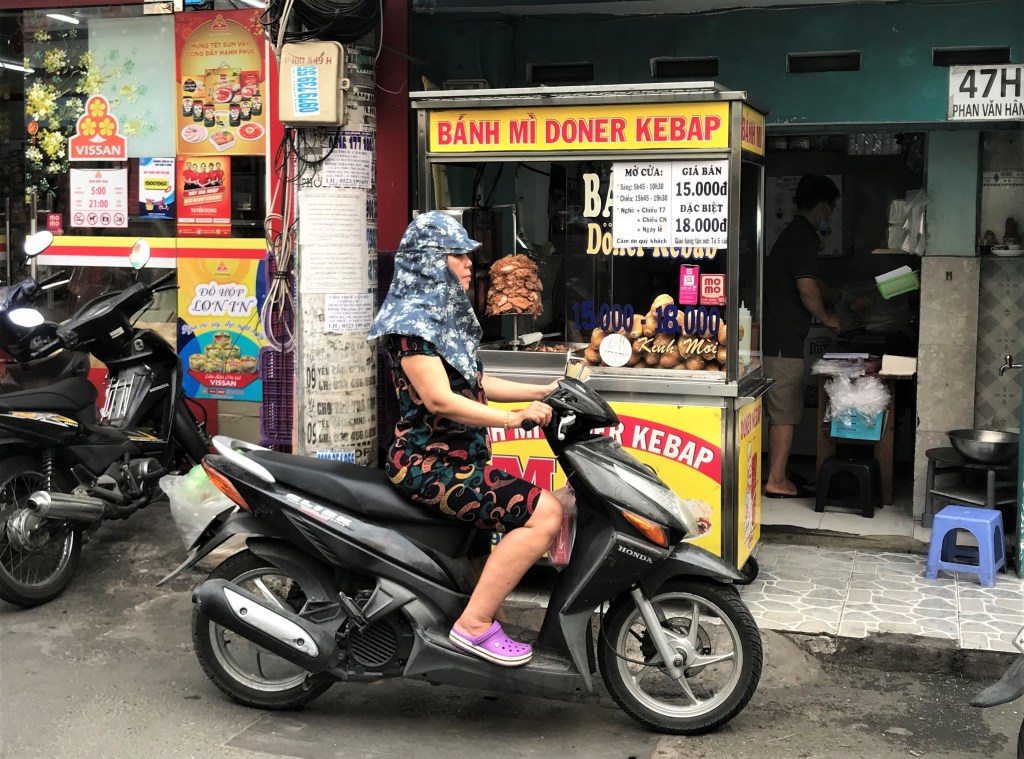
The “street” is lined with shops of all kinds. There are women’s boutiques, jewelers, children’s stores, toy shops, men’s tailors, barbers, salons, home appliance stores. There are butchers, fishmongers, greengrocers, flower shops, coffee shops, a couple of mid-sized supermarkets and one popular báhn mì vendor. All this is in the span of one long block, barely 150 meters (about 500 feet) long.

At 3 in the afternoon on a sunny day, it is a thriving marketplace.

Phan Van Han on a typical afternoon. (JGA photo)

No warning

The attack came suddenly, without warning.

As I passed a private convenience store, my steps were interrupted by a motorbike that swerved toward the store and stopped directly in front of me. My first reaction was frustration with a driver who had ignored my presence. But the young man looked at me and told me sharply in English to “Stay there!”

My reaction was to keep moving. I walked around the bike and its female passenger and tried to continue. But not 15 seconds later, a second bike blocked my way.

It was a bigger bike. The driver was a bigger guy, older and tougher and angrier than the first. He leapt from his cycle and threatened me with a black police baton, waving it in my face as he demanded to see my cell phone.

“Open your phone!” he shouted.

Confused, I was a little slow to produce the mobile appliance. He jammed my left upper arm with the baton. It didn’t feel good.

“Your phone!” he screamed, in perfectly good English. “Show me your ‘Line’ app!”

Line is one of a half-dozen social media apps popular as chat sites in Vietnam. It’s not one that I often use. (I prefer Zalo or What’sApp.) But my assailant knew exactly what he was looking for, as he scrolled through my very limited inventory of Line phone contacts.

As he did so, the first guy — at least, I think it was the first guy — reached into the front pockets of my pants and pulled out anything else he could find. He didn’t want the keys to my house/apartment. He didn’t want the groceries on my back. My wallet, on the other hand, was of interest. He slid it into his own pocket and vanished.

A banh mi vendor on Phan Van Han caters to motorbike riders. (JGA photo)

A naked feeling

I stood naked in the street, fully clothed but utterly dumfounded and disoriented. I remember glancing at a merchant who looked as flustered as I felt. I wanted to ask, “What is happening here?” but no words were escaping my mouth.

Then my phone was being returned to me. The assailant thrust it into my hands. “Sorry,” was all he said, shaking his head. I could only think I was glad he didn’t find his wife’s or girlfriend’s name in the contacts. What else could he possibly have been searching for?

He disappeared.

There was still the matter of my stolen wallet. It not only contained money — about 1.7 million VND (Viet Nam Dong), as I near as I could remember, or about US$80 — but also my Temporary Resident Card (TRC), certifying me to remain in this country. I could do without the cash, but to lose the TRC would be a major headache.

My bewilderment lasted another minute or two, until my pilfered billfold magically landed at my feet, as if dropped by a passing pigeon. Then I heard the vroom of a motorbike passing in the opposite direction and another shout: “Sorry!”

The money was gone, but the TRC was intact.

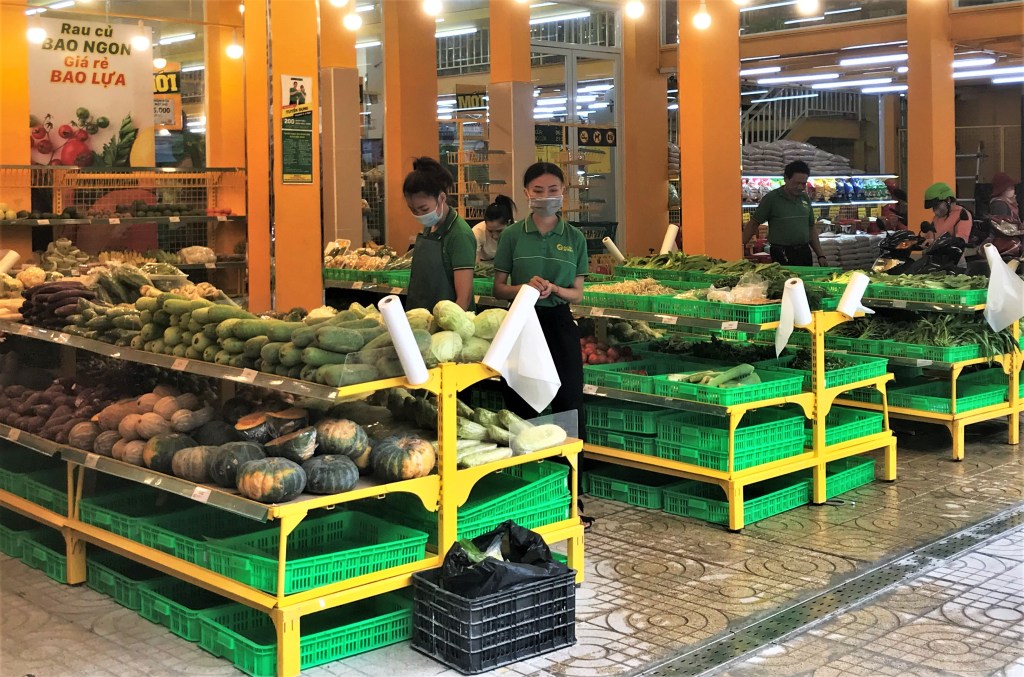
Phan Van Dan supermarket workers rarely worry about holdups. (JGA photo)

Still nervous

The entire episode was over and done with in no more than five minutes. But six months later, I am still nervous about walking down Pham Van Han.

In the big picture, this was not a major event. It was not a rape or a beating. Although violence was threatened, I suffered no physical injury, save a minor bruise.

Nevertheless, I felt fearful, violated, defiled. Post-traumatic stress, I suppose, on a very elemental level. I trembled for days after. Thankfully, it was only days. I can barely imagine how real victims must cope.

Ironically, my close friend Adam Angst, an Australian resident of Ho Chi Minh city, was mugged at almost the same time as I, on the same date, in another part of the city. And another friend and longtime resident, American David, had perceptively warned me never to carry a wallet in the city. “That would be stupid!” he exclaimed, which subsequently gave him the right to say: “I told you so!”

As in any big city in the world, there are horror stories, some of them undoubtedly urban legends, some perhaps not.

In reflection, I’m not sure I could have avoided this attack. I was walking mid-afternoon in an open, brightly lit area with a lot of people. I wasn’t openly flaunting my valuables. It seems I was the guiltless suspect in a jealous boyfriend’s rage.

But my Spidey-sense is now on the alert, lending me at least a hint of misgiving whenever I traipse through an unfamiliar corner of the city.

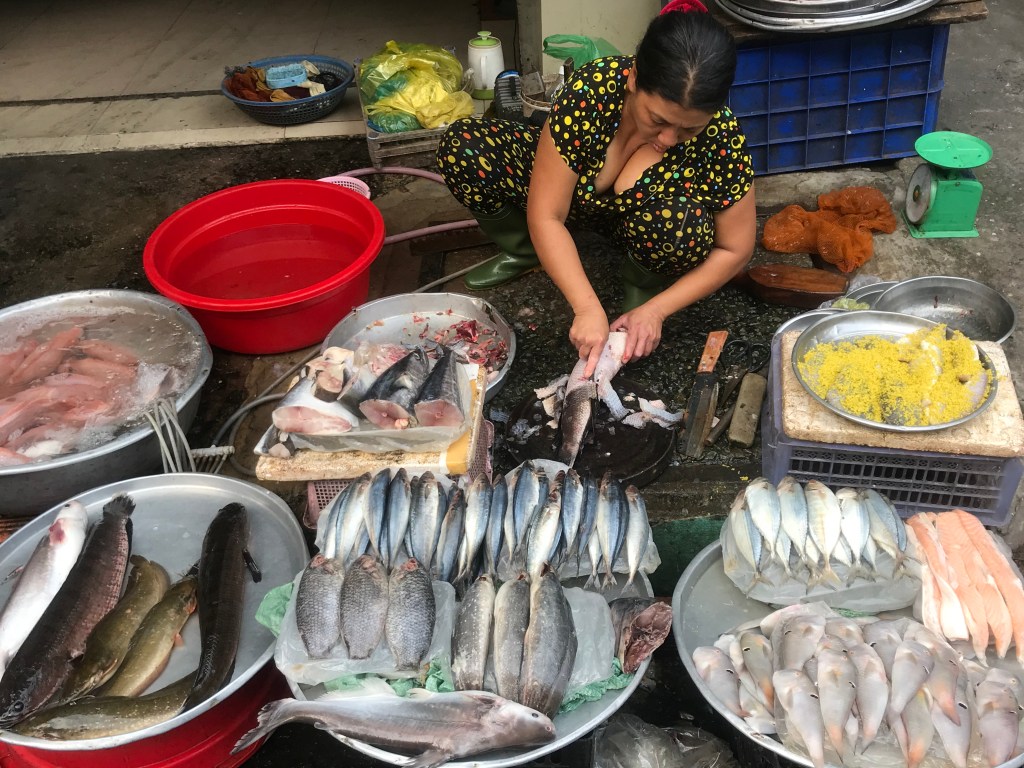
A fishmonger scales and cleans her merchandise on Phan Dan Han. (JGA photo)

Next: The lunar new year

22. A Palace Intrigue

Once the seat of government of republican South Vietnam, Independence Palace is now a “national cultural and historical relic” and an attraction for tourists in Ho Chi Minh city.

Wrought-iron gates welcome visitors to Independence Palace. (JGA photo)

No other structure in Ho Chi Minh City says “South Vietnam” like Independence Palace. Constructed between 1962 and 1966, it was the seat of government of the Republic of Vietnam until the fall of Saigon.

It became an international symbol on April 30, 1975, when a Viet Cong tank thundered through the wrought-iron gate facing Le Duan street, effectively putting an end to what is known here as the American War.

I began my recent visit at these very gates (the newer version thereof). Here, guests pass security protocol, purchase tickets (VND 65,000, or US$2.75) and perhaps also book a guided tour. I chose to move independently, wandering the 30-acre (12-hectare) grounds and taking my time to read interpretive panels, written in excellent English as well as Vietnamese and French. (Audio guides are available in seven additional languages.)

This is a destination for history buffs. As a recent resident of this country, I want to discover as much as I can about this country. I learned a lot here.

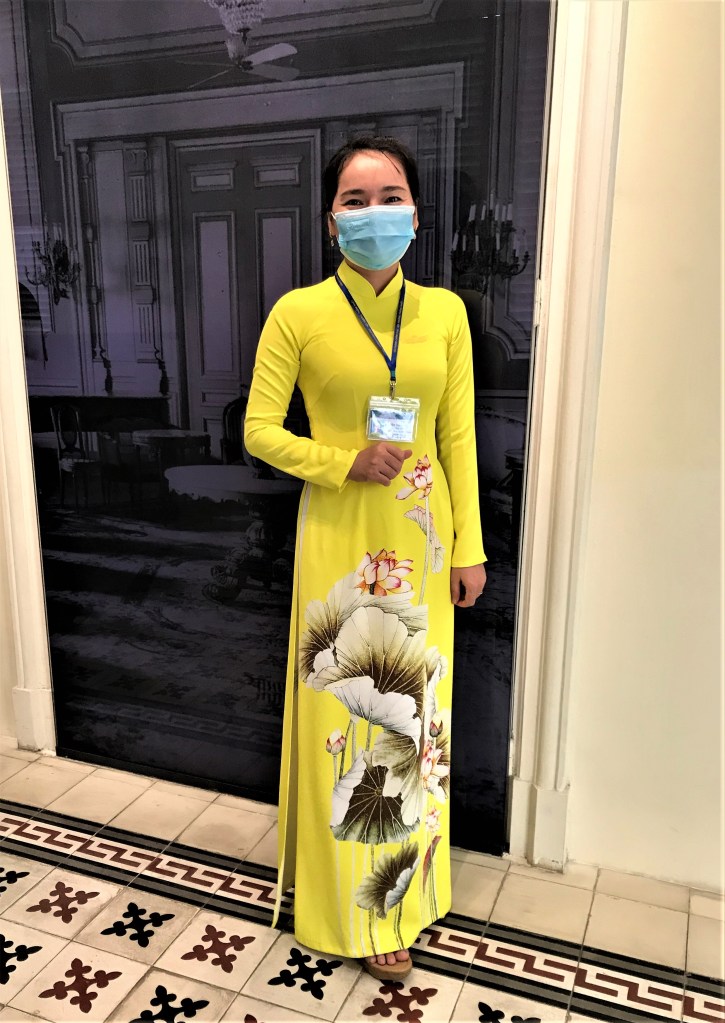
Dressed in a traditional ao dai, a docent welcomes visitors to the exhibits. (JGA photo)

A historical interlude

My first stop was an exhibition hall on the site of the former Norodom Palace, once the seat of French colonial government. France occupied southern Vietnam, or Cochin China, beginning in 1867. The neo-Baroque Norodom Palace was built between 1868 and 1873, and except for six months of 1945, when the Japanese took control, it was the home of the governor-general of French Indochina.

In 1954, after the French defeat at Điện Biên Phủ, France withdrew its troops from Vietnam. The ensuing Geneva Accords established the 17th parallel as a border between communist-controlled North Vietnam and anti-communist South Vietnam, pending general elections to establish a unified government. That never happened.

An ongoing exhibit of historical photos explained how Norodom Palace became the official residence of Ngô Đình Diệm, who had been designated as prime minister following four years of self-exile in the United States and Europe. A year later, he defeated former Emperor Bảo Đại in a referendum, declared himself president of the Republic of Vietnam and renamed the building Independence Palace. But in 1962, after a destructive bomb attack during an attempted coup, Diệm decided to demolish the building and rebuild on the same site.

A family portrait. President Ngo Dinh Diem is at the far left, next to his archbishop brother Thuc.

Diệm consolidated his tenuous power base with his four brothers — Thục, Nhu, Cẩn and Luyện — and Nhu’s wife, Trần Lệ Xuân (“Madame Nhu”). Older brother Thục, a Mekong Delta bishop who was named archbishop of Hué in 1960, corralled Christian support. As Diệm’s top political advisor, Nhu founded the clandestine and fiercely loyal Can Lao Party, which controlled national security and surveillance.

Never popular, Diệm and Nhu were assassinated in a coup in 1963, three weeks before U.S. President John Kennedy was slain. The new Independence Palace, which combined modern European elements with traditional Asian style in a design by architect Ngô Viét Thu, wasn’t completed until the end of October 1966. When General Nguyễn Văn Thiệu became president in 1967, it became headquarters for South Vietnam’s government and home for the general’s family.

In addition to the historical chronology, the exhibition hall features intriguing videos and models of Ho Chi Minh city as it appeared in the pre- and post-colonial era of Norodom Palace.

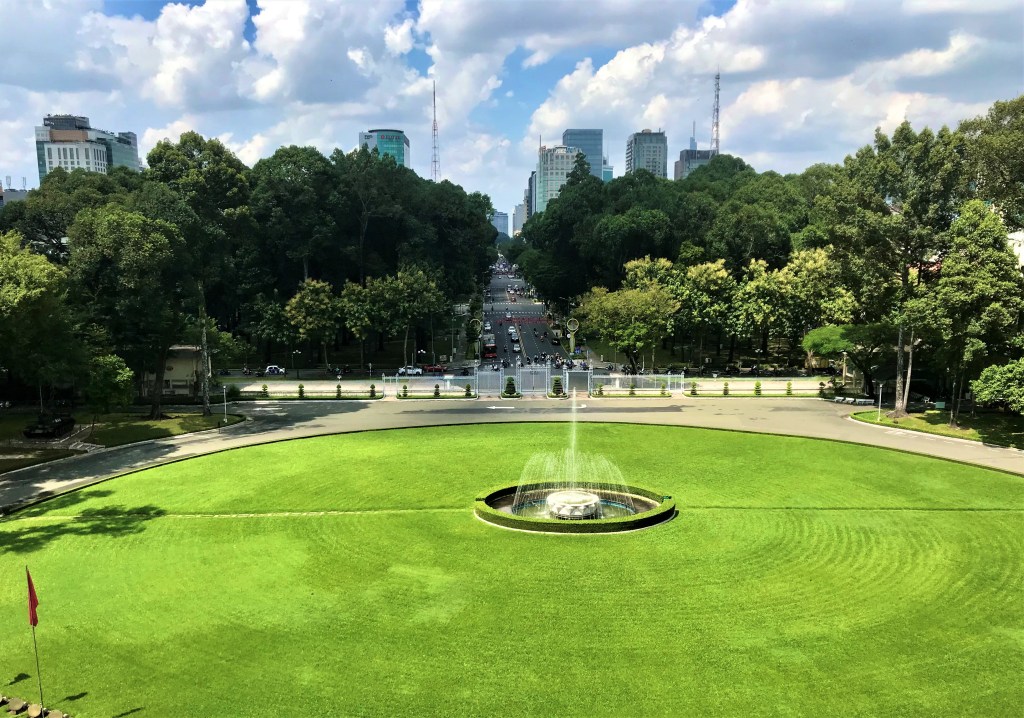
The view from Independence Palace extends across an oval lawn to Le Duan street. (JGA photo)

Feng shui design

The main entrance to Independence Palace (also called Reunification Palace) sits atop a flight of broad steps that overlook an oval-shaped lawn. I can still recall television news footage of a U.S. military helicopter lifting off from here in 1975, evacuating the last American troops from Saigon. I was working in New Zealand at the time; it was an international event.
The Palace appears to the undiscerning eye (my own) as an undistinguished contemporary building of the 1960s. But its layout welcomes natural lighting, and it is true to the traditional Eastern philosophical design principal of feng shui. Chinese symbols for auspiciousness, fidelity, humanity, intelligence, strength and prosperity are all incorporated into the design, and there are stylistic nods to the imperial architecture of Hué in its stonework and outlying ponds and gardens.
As the new Vietnamese government was headquartered in Hanoi, the Saigon site had only adjunct usefulness. Today it appears much as it did 48 years ago, its bright, broad corridors opening into expansive reception rooms and offices. Most of these are roped off, viewable only from the outside, but well worth inspecting for their displays of Asian art, including original works, antiques and “presidential gifts.”

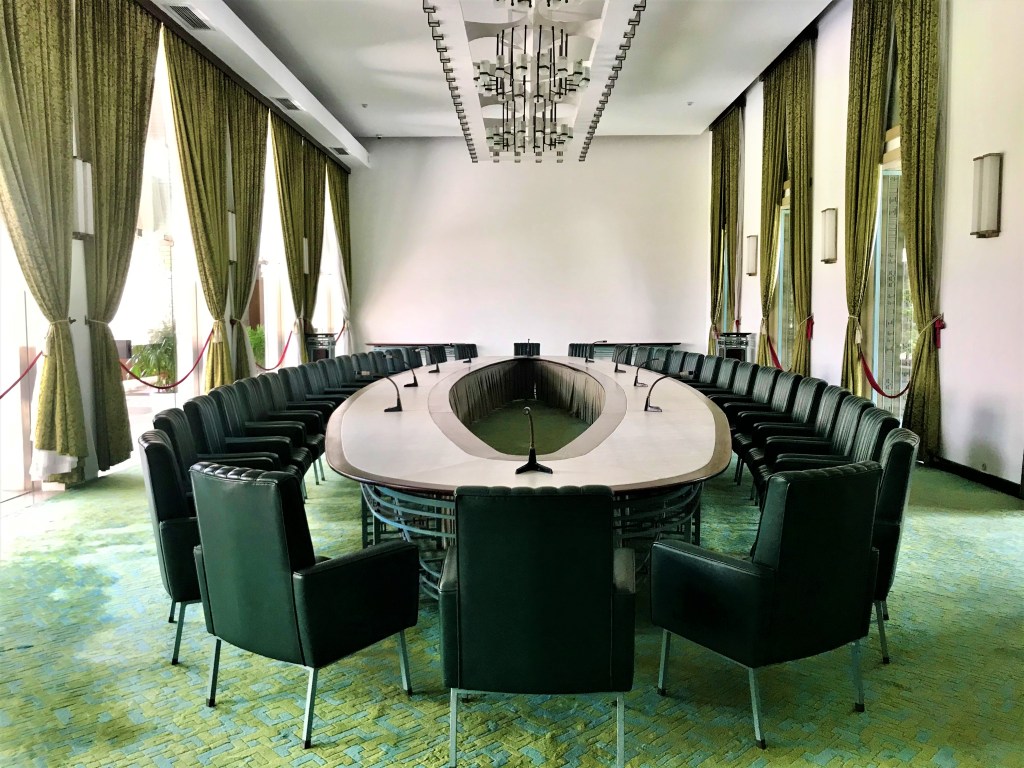
Thirty-six chairs surround the table in the Cabinet Meeting Room. (JGA photo)

A central staircase climbs from the main public-reception level to the first floor. Here, 36 chairs around the ovate central table in the Cabinet Meeting Room suggest a lot of voices wanting to be heard. Nearby is a banquet hall and the elaborate Conference Hall, still used on special occasions.

The second floor contains the offices of the president and vice-president and their respective reception rooms. (U.S. secretary of state Henry Kissinger was received here in 1972.)  The National Security Council met in its own chamber on this floor. And the Nguyen family’s private quarters, including bedrooms and a dining room, were also on this level.

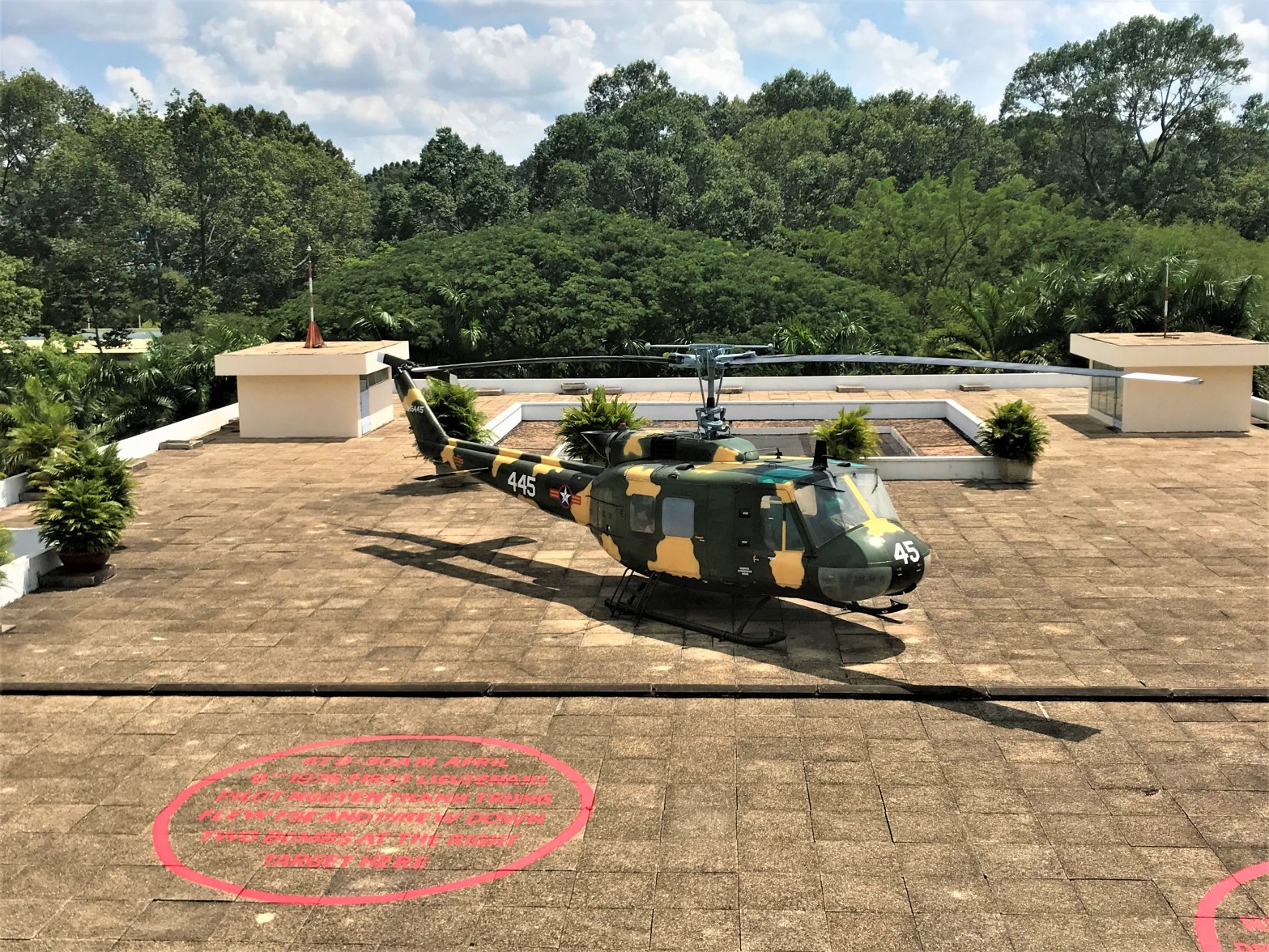
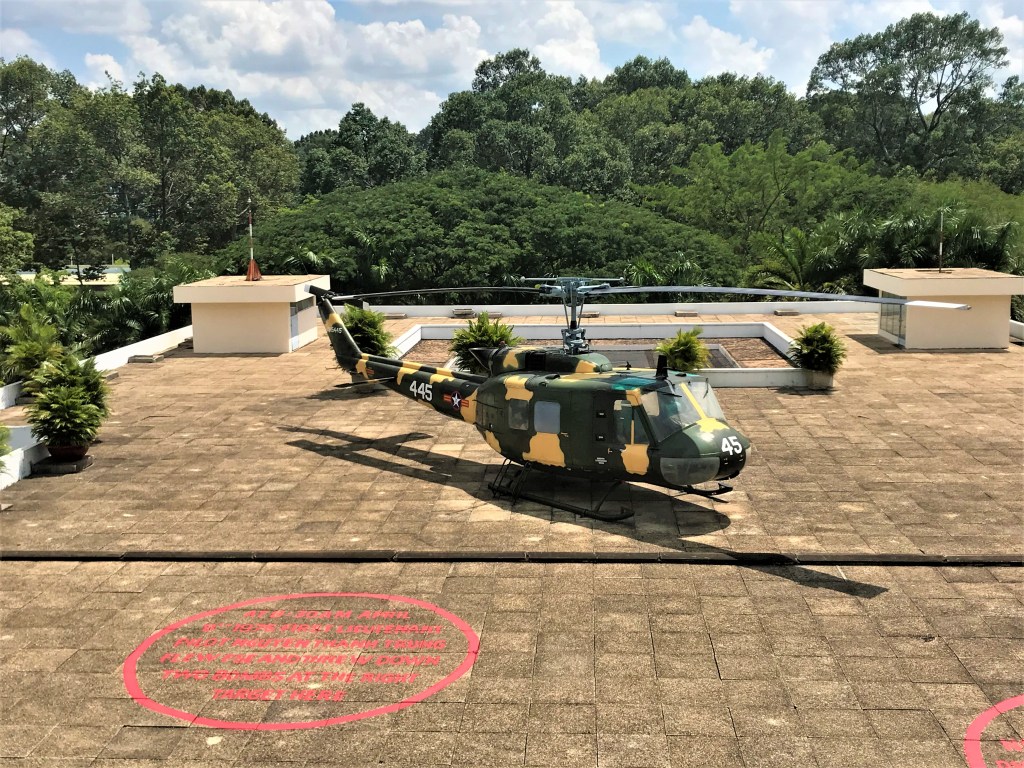
A vintage HC-1 U.S. helicopter sits atop the palace heliport. (JGA photo)

The third floor might best be described as the entertainment center. It had a cinematic theater, a library and a gaming room, with a billiards and casino-style cards tables. Vietnam’s first lady had her private reception room here. A mezzanine extended to a helipad that was bombed by a renegade South Vietnamese air force pilot three weeks before the capitulation of his government.

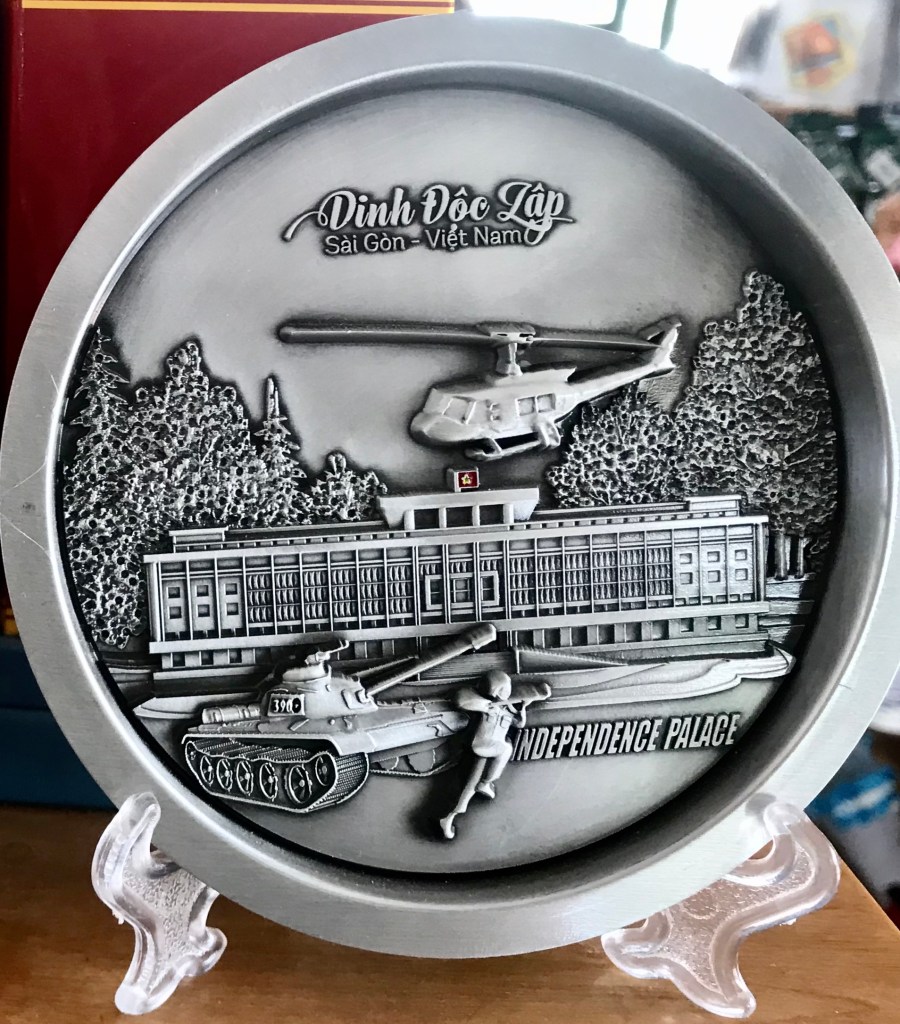
That helipad (featuring an American helicopter) is better seen from the rooftop terrace, which also affords good views across the city and the palace grounds. A souvenir outlet here sells a variety of memories that glorify Vietnam’s victory, including toy replicas of two original Russian tanks that are parked on the palace lawn.

A souvenir coin is a popular takeaway for palace visitors. (JGA photo)

Digging deep

For many visitors, including myself, the most interesting part of a palace tour is a descent to the basement, where the South Vietnamese government maintained its command center and a presidential bunker — in rooms linked by tight passages and protected by reinforced concrete walls designed to withstand bombs.

A bank of telephones sits ominously in the underground command center. (JGA photo)

It doesn’t take much imagination to envision the military intelligence operations that were coordinated here. Rows of telephones, telex machines and short-wave radio transmitters were left just as they were in April 1975. Walls of maps followed soldiers’ activities north and south of the 17th parallel. One of them tracked the infamous supply network known as the Ho Chi Minh Trail and its spurs, extending from Hanoi to the Mekong Delta, within striking distance of Saigon.

President Nguyen’s spartan quarters only hint at isolation. (JGA photo)

The blast walls in the maximum security shelter were four times as strong as those in the command center. President Nguyễn had direct access via a staircase from his second-floor office, and on April 8, 1975, when the palace was initially bombed, his entire family took refuge here. That’s hard to believe now, when his “bedroom” is depicted with a single bed, two phones, and nothing more.

But Nguyễn Văn Thiệu’s much-loved Mercedes-Benz 200 is still parked in the bunker, just around the corner from his secure room and down a hall from a shooting range where target practice was, presumably, a frequent recreation.

A shooting range provided diversion in subterranean lockdown. (JGA photo)

Next: A daylight mugging

21. My Motorcycle Song

Ho Chi Minh city can be a lonely place if you’re not ready to climb aboard a motorbike. But beware the crosswalks.

Mid-afternoon motorcyclists cross the Thi Nghe bridge between Da Kao and Binh Thanh (JGA photo)

“I don’t want to die,” crooned Arlo Guthrie, the American folk singer. “I just wanna ride on my motorcy — cle.”

Virtually every day of my life in Vietnam, I am on a motorbike. Fifteen months ago, I never would have believed this would happen. I had previously spent hundreds of hours and thousands of miles on bicycles, but (except for a four-day odyssey around Bali in 1976) almost never on a motorized two-wheeler.

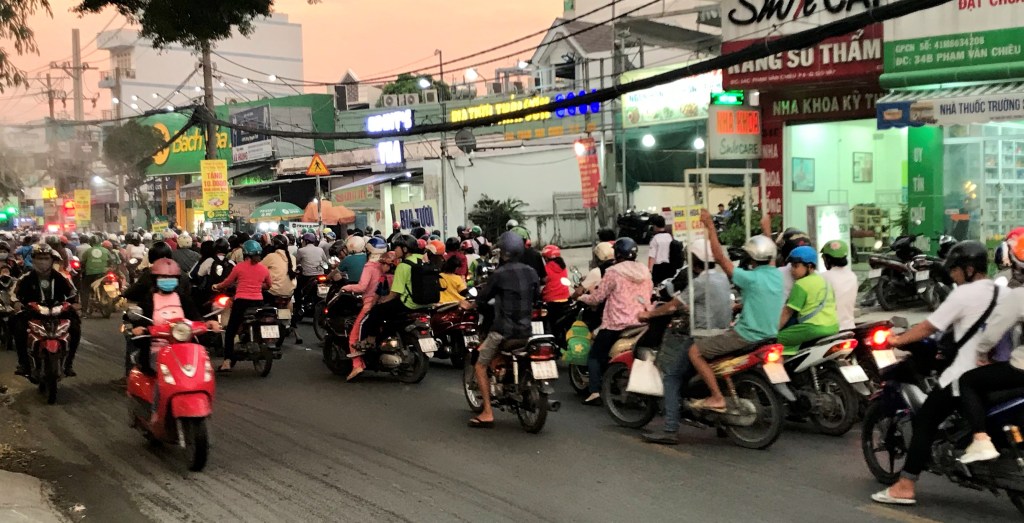
Motorbikes outnumber cars (and trucks and buses) in this country by multiples. There are 65 million registered motorbikes in a country of 100 million people. And that doesn’t include highly fuel-efficient 50cc bikes, which are not required to be registered. There are perhaps another 10 million of those.

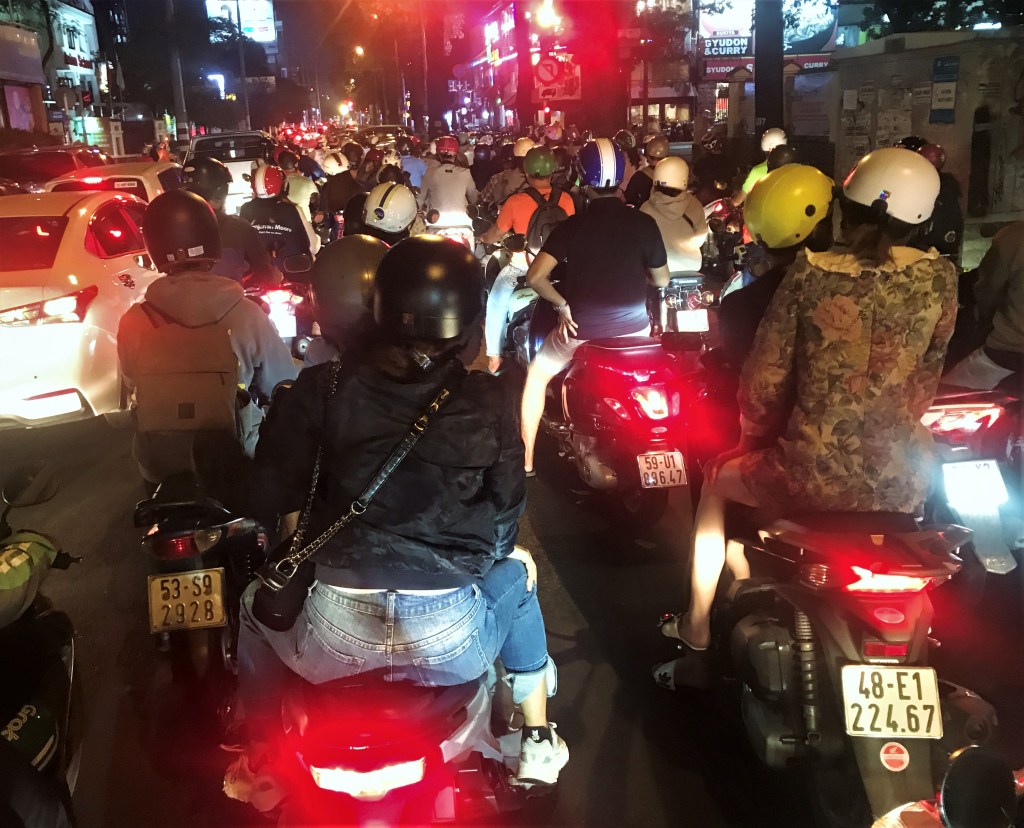
In Ho Chi Minh city alone, a metropolis of some 13 million people, more than 8.5 million motorbikes are in use, their horns beeping endlessly. They share eight-lane arterial highways and tiny lanes not wide enough for one bike to pass another. Empty lots become de facto parking areas, as do sidewalks and, often, private parlors and living rooms. Business opportunities abound for parking attendants and security guards who can assure the safety of these vehicles for their owners.

A motorbike parking lot in the Da Kao ward, District 1, Ho Chi Minh city (JGA photo)

Filling the gaps

All riders must wear fitted helmets, subject to a fine of around US$10; Most do so, although flip-flapping straps are almost as common on drivers as flip-flop sandals. Motorcycles also must not exceed 50 kilometers per hour (31 mph), but few riders are true to that law. They are not patient drivers.

Indeed, it seems most have the same perspective as building contractors: If there’s a gap, an empty space, fill it. Don’t wait behind a half-dozen other bikes at a traffic light when you can wheedle your way through the breach between a bike and a commercial van to get 10 meters closer to the stop line. And if the congestion is too stifling — well, there may be a sidewalk where you can negotiate a passage between pedestrians and mobile kitchens.

Right-of-way between motorbikes is determined by whose tire is ahead of the other’s. Right-of-way for pedestrians is determined by … well, there is no right-of-way for pedestrians. As I wrote in an earlier blog post, my first big culture shock came in merely crossing a street.

An elderly man finds his way through motorbikes in a District 6 crosswalk. (JGA photo)

Negotiating a crosswalk, even with a green walk light, is always an adventure. The key is to wait for an ever-so-minor break in traffic and begin walking slowly and steadily. As long as you don’t stop and start, as long as you maintain a steady pace in the direction you’re going, drivers are very good at gauging your stride. They won’t stop, they rarely even slow down, but they veer at all the proper angles.

If you remember the 1980s video game “Frogger,” you’ll have some idea what it is like. Local TV hostess Tracy Thuy Hoang gave me this advice: “When you want to cross the road with so many motorbikes, do not worry. Close your eyes, and then keep walking straight. But during that time, don’t forget to pray to your god. And then you can cross the road!”

Taking the dog for a ride on Vo Van Kiet. (JGA photo)

Safety issues

Fourteen thousand people die on the road in Vietnam every year. In Ho Chi Minh city, the death rate is about 20 per day. Traffic fatalities are the leading cause of death for men and women between the ages of 15 and 29, and motorcycles are responsible for more than half of those deaths. Traffic congestion, inadequate law enforcement, poor driving skills and bad street conditions are often cited as reasons. Police may turn a blind eye or accept a private cash settlement to avoid ticketing.

No doubt, motorbike exhaust contributes mightily to the frightening level of air pollution in both Ho Chi Minh city and Hanoi. In recent years, both cities have proposed schemes to ban motorbikes from the urban core to discourage traffic congestion. By 2030, boosted by new subway systems projected for completion before that time, full-sized motorcycles could be relegated to urban fringes. Already, local manufacturer VinFast is producing smaller electric scooters, cutting into the profits of Honda and Yamaha, who have dominated the motorcycle market in Vietnam for 50 years.

A quick District 5 market stop after work and school. (JGA photo)

Motorcycles aren’t going to go away. For many families, they are the principal means of transportation. It’s common to see mom, dad, three kids and the family dog sharing a single bike. And they carry staggering amounts of goods, as well as people: Visitors are often surprised to see how much can be stacked on a bike. Rather than renting a pickup truck or other four-wheel vehicle, placing the burden on a bike saves time and money.

Motorbike commute

Now, here I am on a motorbike. The cycle isn’t my own, but the helmet is; it’s an Andes, a solid piece of equipment that cost me about VND 300,000 (US$12.75).

Every day, I travel the 6.2 km (3.9 miles), between my home in the Binh Thanh district and my work place in District 6, by taxi — motorbike taxi, that is. By day, it costs me about VND 43,000 (US$1.83). By night, there’s a surcharge of another 20 percent. When I call a bike to take me into the heart of District 1, it costs well under US$1.

A GoJek motorbike taxi driver pauses at a stoplight. (JGA photo)

There are two main ride-sharing services. Singapore-based GrabTaxi merged with Uber in 2018; Grab controls the market in countries throughout Southeast Asia. GoJek (formerly Go Viet) is a newer startup that offers service of similar quality for a substantially lower price. GoJek, has recently added a line of cars; during rainy season, Grab automobile taxis are welcomed by non-drivers who will pay more to stay dry.

A growing number of drivers speak sufficient English to communicate with foreign riders.  Although some pay insufficient heed to safety, hygiene or most convenient routes, the vast majority of drivers are excellent.

Late-night traffic on Duong 3/2. (JGA photo)

Tracy Thuy told me that if a man wants a serious girlfriend in Ho Chi Minh city, he’s going to have to shell out for a motorbike of his own. I’m not sure that’s worth the risk, as an inexperienced rider, of braving the traffic — especially when there are others who can do it for me!

It’s never a bad time for a nap. (JGA photo)
Rush hour in the Go Vap district. (JGA photo)

Next: Independence Palace

20. Flying High in Mui Né

The Vietnamese beach town of Mui Ne is one of the best places in Southeast Asia to take up the sports of kite surfing and paragliding.

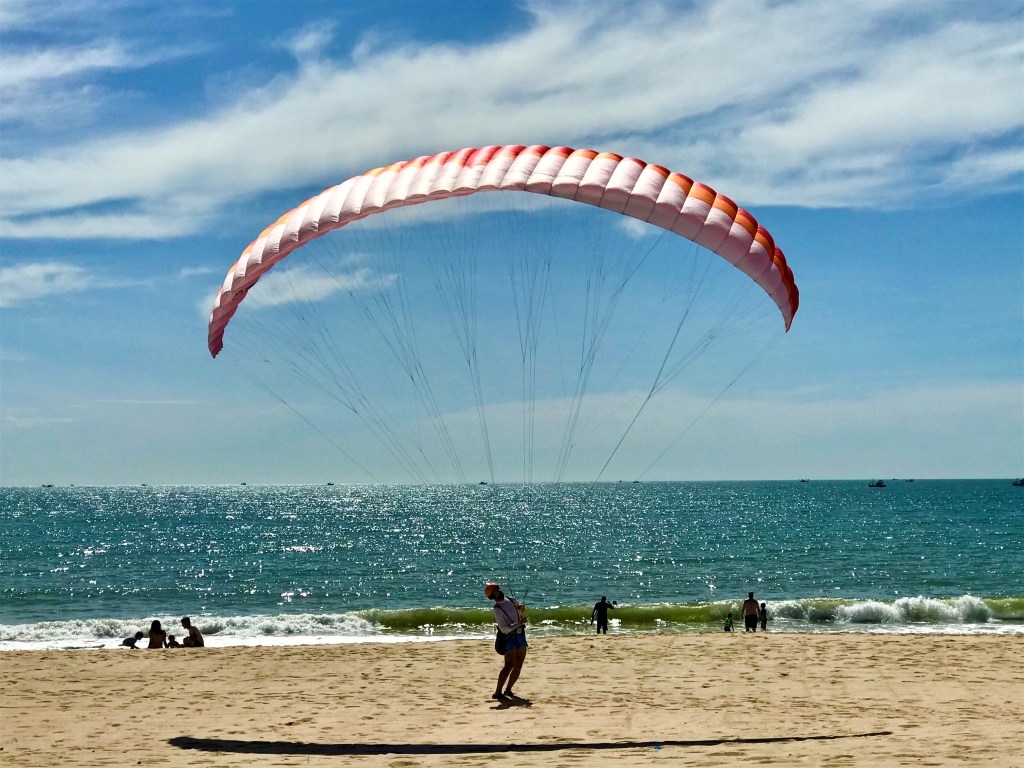
Nick unfurls his paragliding wing beside the South China (East) Sea. (JGA photo)

“It’s a lot like drugs,” said Nick, the globetrotting Frenchman. “You can get addicted really easily.”

I had no reason to doubt him. My friend Bill in North America would echo these words. It wouldn’t be a stretch to say that both of these gentlemen are junkies.

Oh, not on substances, for heaven’s sake. They get high in a different way. They may uncap an occasional beer or uncork a smooth Bordeaux, but it’s their obsession with the wind that carries them through the heavens beneath a synthetic fabric wing.

Nick and Bill are aficionados of the sports of kite surfing (or kite boarding), a nautical ballet if ever there was one, and even more so, its close cousin paragliding, which they also can enjoy on land … or even snow.

You’re most likely to encounter Bill, who has visited Vietnam but who lives in western Canada, sailing beneath his maple-leaf emblem off the heady cliffs atop Grouse Mountain, near Vancouver. The season doesn’t matter. Nick, who like me makes his home in Ho Chi Minh City, pursues his passion by the sea.

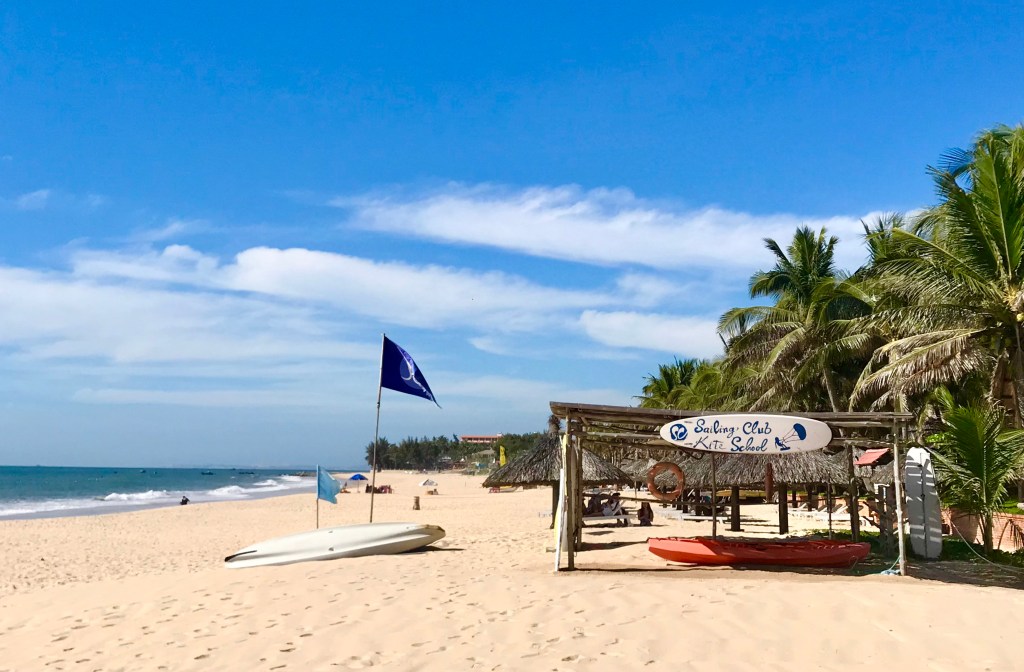
The Sailing Club offers kite surfing lessons on Mui Ne beach. (JGA photo)

The Sailing Club

In Vietnam, there may be no better place to learn and practice kite surfing and paragliding than the sands of Mui Né, 225 kilometers (140 miles) east of HCMC.
Carving a gentle crescent, the south-facing beach at Mui Né extends for more than 10 kilometers (6 miles) along the South China Sea (here known as the East Sea). The main coastal road, Du’ong Nguyen Dinh Chieu, is home to a couple of dozen resorts, most of them low-rise properties with lush gardens stretching from the highway to the beach. Cheap guest houses and a surprisingly international choice of budget restaurants gather on the inland side of Nguyen Dinh Chieu.
Numerous schools teach kite surfing. They have hung their shingles above the beach sands, especially in the area known as Ham Tien, near the west end of the strip. This is said to be the area with the best winds, especially between October and April.

I met Nick at the Sailing Club Resort after a crab Benedict breakfast at Sandals, the resort’s lovely seaside restaurant. The Frenchman was furling his colorful “wing” when I approached and asked some questions about his sport.

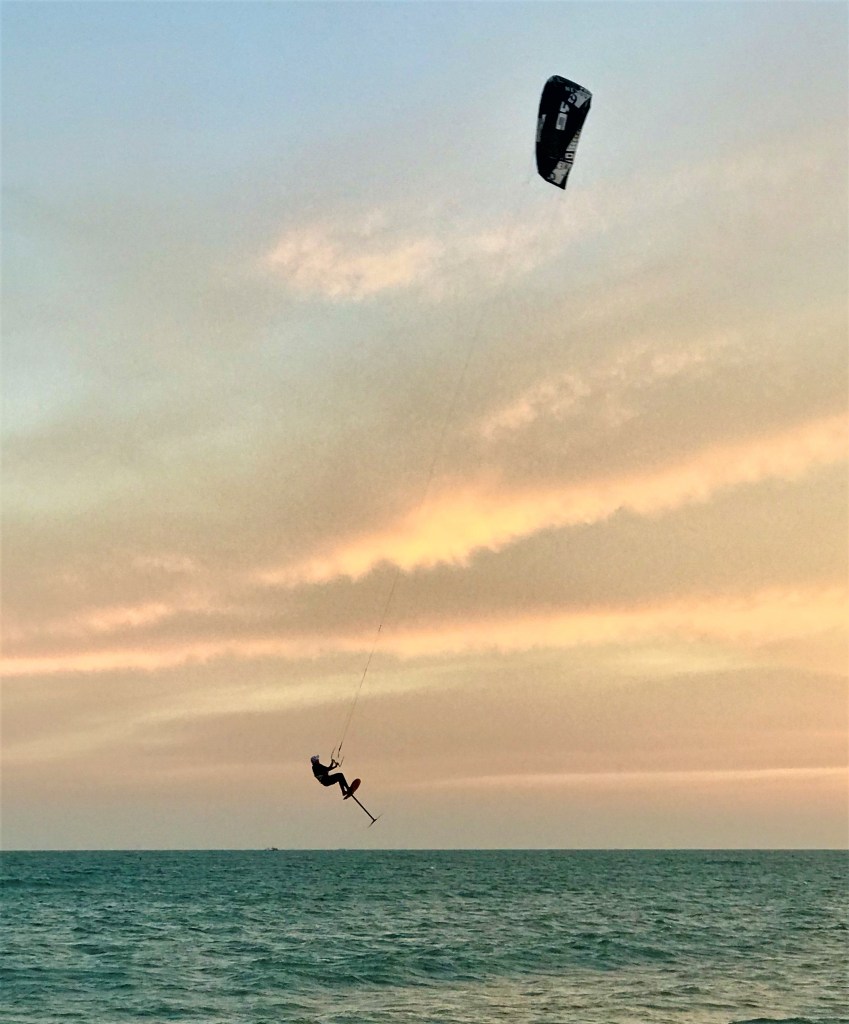
A kite surfer on a foilboard soars high above the ocean. (JGA photo)

Steady winds

He had not been kiteboarding, he asserted — indeed, he had no board. The surfer I photographed the evening before had been on a foilboard, with a hydrofoil that extends a meter below the board to provide loft. He wore a harness and held a control bar, with about 20 meters (65 feet) of lines attached to an inflatable “power kite.”

Nick was enjoying what Bill and I would call paragliding. Like a kite surfer, he looks for steady regular winds, not gusts, and he controls the lightweight, free-flying wing by means of suspension lines that extend from his harness. Beyond that, it’s all aerodynamics. He can stay aloft for hours, wearing only beach clothes, a fanny pack and a helmet, and easily cover the kilometers from one end of Mui Né beach to the other.

Paragliding is notably different from parasailing (a person is towed behind a boat with little or no control over the chute) and hang gliding (the pilot is harnessed into an aluminum frame covered with sailcloth, a far more intrepid adventure).

Nick said he especially likes kiting over Mui Né’s white sand dunes, about 24 km (15 miles) east of the main beach strip. With a short run down a sandy hill to catch extra wind, he can climb several hundred meters above the surrounding landscape for spectacular views.

Daunting dunes

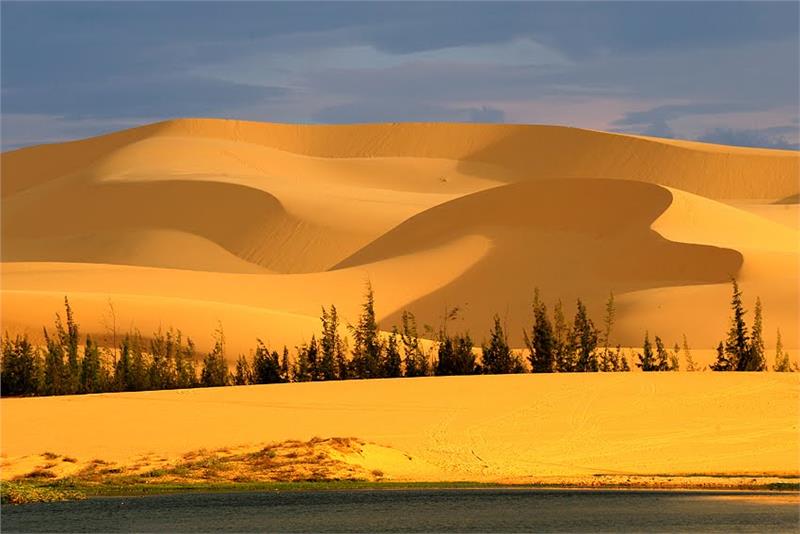
Indeed, after the beach itself, the dunes are the #1 attraction in Mui Né. As a native of America’s Pacific Northwest, I’ve been jaded by the expansive Oregon Dunes National Recreation Area, but Vietnam’s white dunes (in reality a pale yellow in color) are impressive in their own right.

I only saw these dunes as I rode through on a bus from Phan Rang. But I could see some of the local concessions that Lonely Planet warns tourists about — dune buggies, quad bikes and plastic sleds. I did not observe any evidence of ostrich riding, but apparently that is an activity as well.

Much nearer to central Mui Né are the so-called “red dunes,” whose ochre color is more like Moab and less like the Sahara. They are dissected by a small stream that is fed by pretty Fairy Spring; a trail through rock formations begins not far from the original Mui Né fishing village.

Mui Ne’s “white sand dunes.” (Photo from tourinsaigon.com)

Tourist town

Everyone, of course, has a different experience when they travel. I’m the guy with champagne tastes and a beer budget, so I tend to cover both ends of the spectrum.

I do a lot of walking. And because Mui Né is laid out in a single long strip, it’s a great place for people like me, as well as for joggers. I easily logged a couple of kilometers in either direction from my guest house, and I noticed numerous runners — all of them Westerners — on the sidewalks. There’s little concern for dodging traffic here, unlike in the big Vietnamese cities.

The main cho, or public market, is in the village itself. I didn’t make it that far. But my walks took me past other interesting locations. I enjoyed my visit to the Chùa Phu’óc Thiên pagoda, ornate but tasteful, with lovely gardens and a whimsical statue of a laughing Buddha in its courtyard. The Bo Ke seafood stalls offered a tantalizing selection of critters of all kinds, including some I swear I’d never seen before.

Mui Ne’s Chùa Phu’óc Thiên pagoda. (JGA photo)

In a tourist town, the street signs, especially those on restaurants, tell a story about where tourists come from. In Mui Né, there were as many signs in Russian as in English. European Russians may seek sun in the Mediterranean, but Asian Russians — those from Vladivostok, Khabarovsk, Irkutsk and other large cities — are drawn to Vietnam, in part I’m sure because of a shared political philosophy. Indeed, the large coastal city of Nha Trang, as far north of Mui Né as HCMC is west, may have a larger Russian population than even Hanoi.

Eclectic options

But I didn’t eat at any of those, although the Ararat Armenian restaurant may well get my attention on my next visit to the beach. This time, I dined at the Sailing Club’s Sandals restaurant, at the SaiGon MuiNe Resort (grilled grouper), and at the Villa Aria Mui Ne (a seafood platter), all with tables overlooking the sands as the sun went down.

Later in the evening, I visited the Filipino staff at El Latino, a Mexican restaurant that took no offense when I directed the bar staff in how to make a proper margarita. And I wound up at Joe’s Café, a local institution where two live bands perform nightly. It was an entertaining stop, but the bearded Irishman who led a band that tried to funk-ify Marvin Gaye sent me scurrying back to my lodging.

A margarita at El Latino restaurant. (JGA photo)

That would be the NoStress Guest House, a garden spot if there ever was one. Set on a hillside a couple of hundred meters above the main drag, its dozen-or-so guest rooms share a unique vista of green — as in tropical plants large and small, accented by ceramic tchotchkes and a fringe of pink bougainvillea. At US$10 a night, the private room was simple and spacious. It would have been lovely, were it not for the roosters that began crowing at 4 in the morning, and the neighborhood dogs that soon joined the chorus.

I returned to the beach at the Sailing Club on my final morning and thought about my previous meeting with Nick, the adventurous Frenchman.

“It’s easy to learn,” he said of paragliding. “And it doesn’t really take a lot of strength.”

I told him that my only previous experience at the sport was a tandem descent through the clouds at Jackson, Wyoming, in the shadow of the Grand Teton mountains.

“Then I definitely think you should do it!” he exclaimed.

I’ll be back in Mui Né. And now I have another reason.

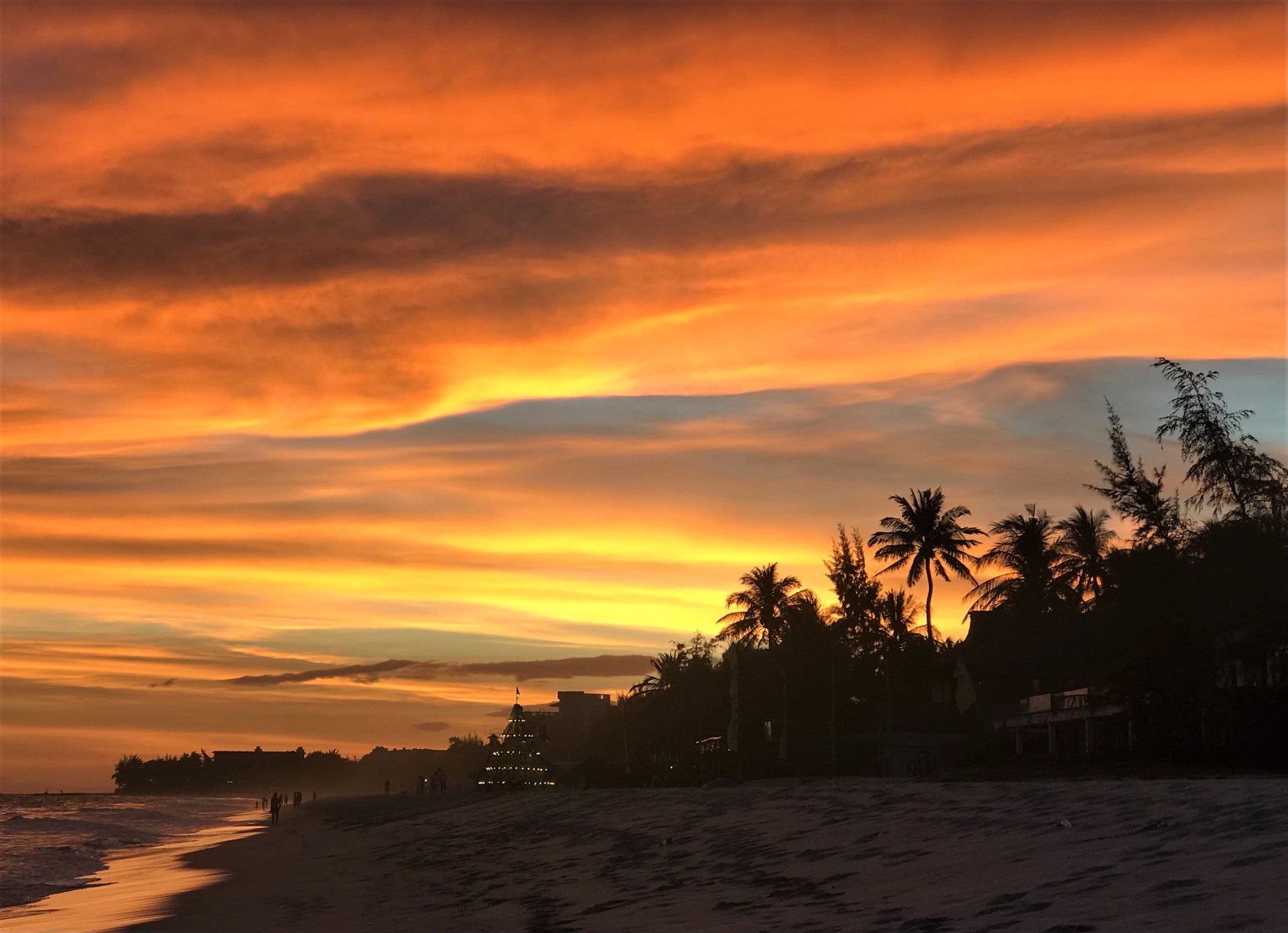
Sunset on Mui Ne beach. (JGA photo)

Next: My motorcycle song

19. Crazy About DaLat

Visitors may marvel at the quirky Hang Nga Crazy House, but that’s not the only architectural oddity to stir interest in this Central Highlands city.

The yellow Da Lat Opera House rises on a low hill near downtown. (JGA photo)

It is often said that highly creative people may be a little crazy. That being the case, the hill town of DaLat seems to have more than its fair share.

The quirky architecture found in this community of 350,000, about 240 kilometers (150 miles) northeast of Ho Chi Minh City, contributes mightily to its stand-alone quality among Vietnamese cities. An undeniable streak of independence inspires artists, entrepreneurs and conservationists to turn from convention and do things their own ways. From coffee farmers to wildlife guides, oil painter-chefs to wine producers, there’s a place for anyone here. Eccentricity is not just accepted; in some circles, it’s the norm.

Looking south across the waters of Hồ (lake) Xuân Hương, two hillside structures capture an onlooker’s eye near the Eiffelesque spire of a radio tower. One of the buildings is roundish and yellow, like a half-buried pineapple lying on its side. The other resembles an artichoke. They are hardly the concepts from which socialist dreams are nurtured and grown.

The courtyard of the Crazy House is sheltered by a giant banyan tree. (JGA photo)

More Dali than Disney

The same might be said of Dr. Dang Viet Nga’s Hang Nga Crazy House — if the architect were not the daughter of Trường Chinh, a Vietnamese Communist party leader through the years of war with France and the United States.

This eccentric estate, formally dubbed Hang Nga (“Moon Goddess”) Villa, is truly an architectural oddity, more Gaudi than Gehry, more Dali than Disney. Nga, who studied and practiced architecture in Moscow from 1959 to 1972, moved to DaLat in 1983 after a decade with the cultural ministry in Hanoi. She designed and began to build the house in 1990 and called it complete 20 years later. But it clearly remains a work in progress, as there are plentiful signs of ongoing construction both inside and outside.

Frightening fingers creep down an arboreal wall at the Crazy House. (JGA photo)

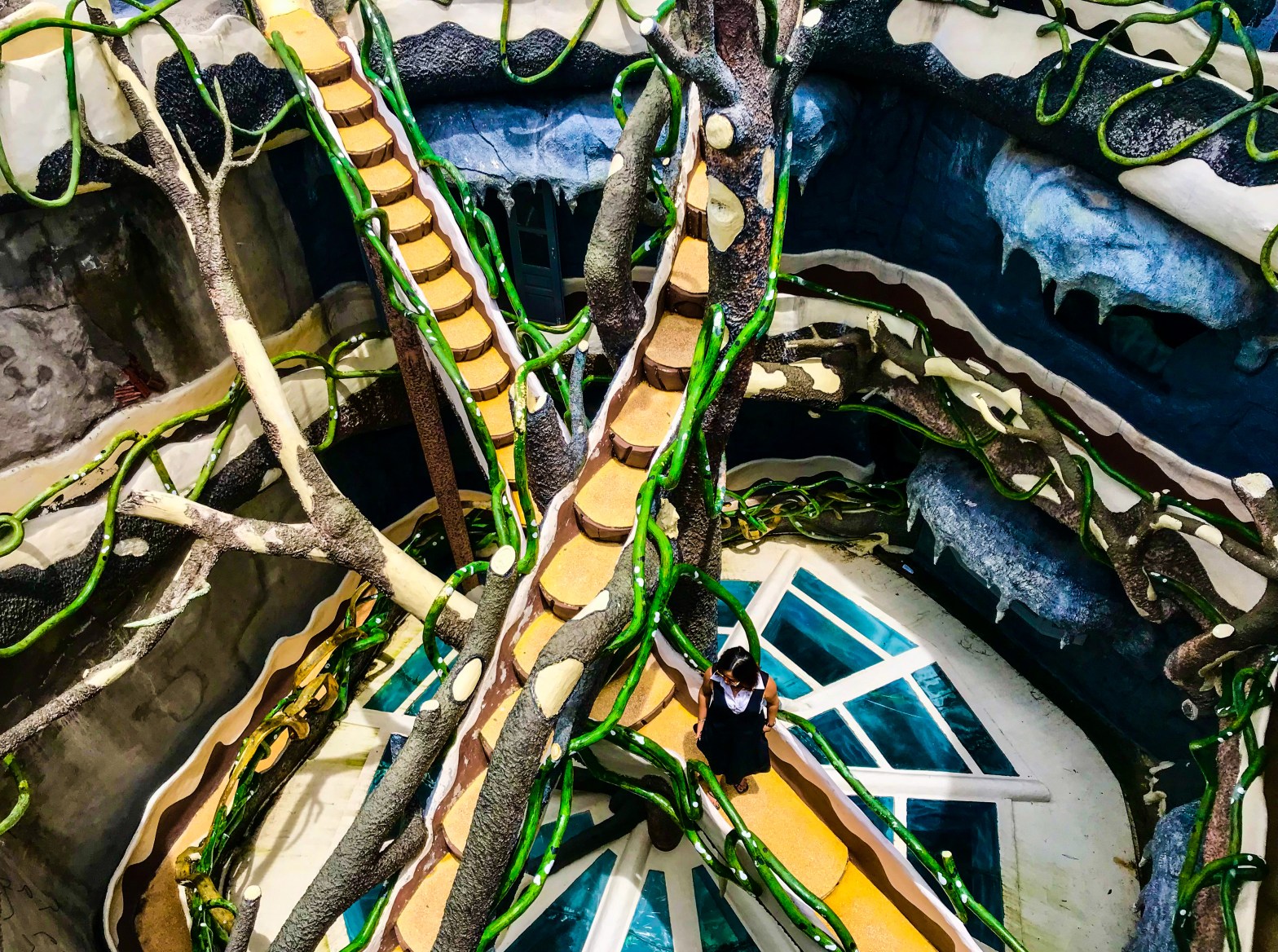
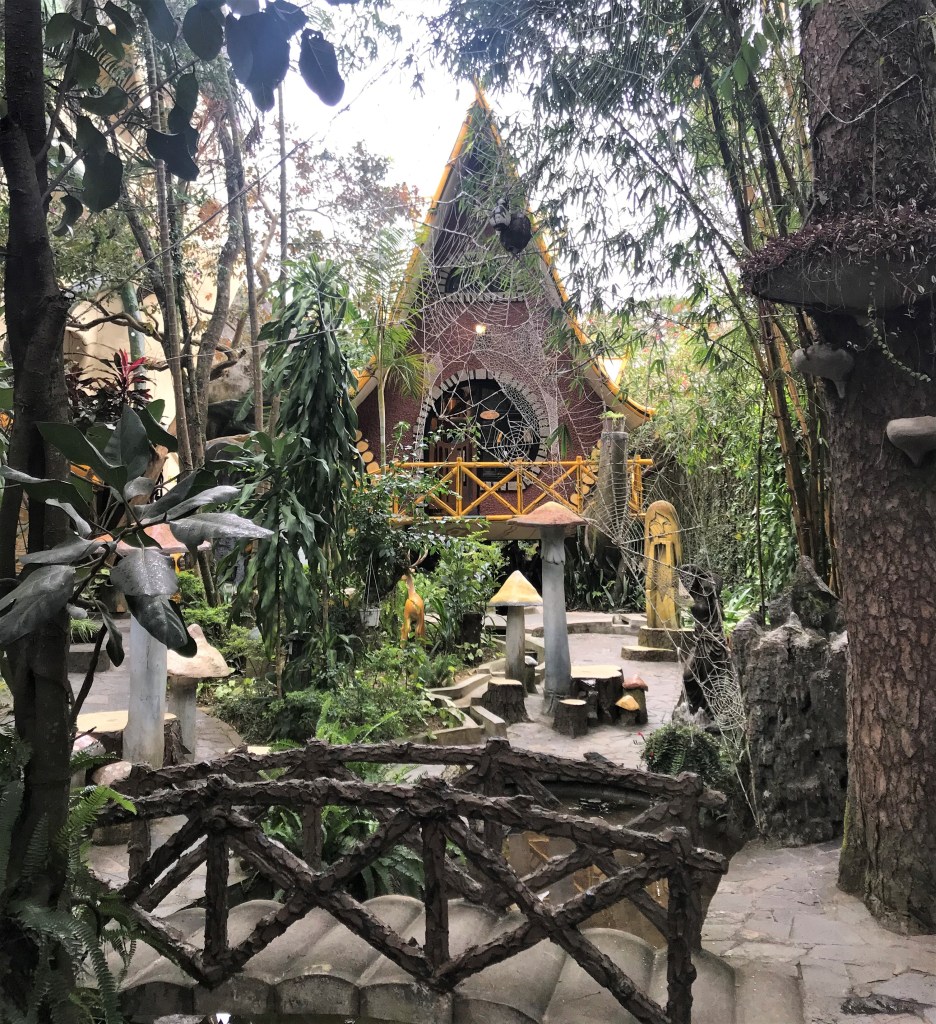
Entering the complex (where Nga, now in her 80s, still lives) is like following the March Hare down the rabbit hole, or tracking Peter Pan’s Lost Boys into their arboreal refuge. From a courtyard beneath a fanciful five-story banyan tree, seemingly directionless staircases climb to slender bridges with jungle-vine handrails. These link a series of audaciously decorated rooms — some straight out of J.R.R. Tolkien, others, like the “Ocean Room,” more Jules Verne — and colorful outdoor areas.

Bony red hands that creep down a garden’s giant tree-trunk wall seem more attuned to a horror film than to a freewheeling forest. But turn a “corner” (there are no straight lines or angles here) and you’ll find yourself passing a … guest room? Yes, the Crazy House is also a boutique hotel. Rooms are sculpted like caverns within the hollows of what appear to be giant roots, their spider-web windows one more example of Nga’s commitment to recreating a whimsical natural environment.

A guest room at the Crazy House appears to be hollowed from a tree root. (JGA photo)

Fruits and veggies

The “pineapple” on the hillside above the lake is the Da Lat Opera House, which opened in 2020 at a cost of over US$3 million. With a three-story theater and an 850-seat outdoor auditorium, the concert hall was specifically designed to present performances of live classical and acoustical music and to attract international festivals. There’s a gallery for art exhibitions, as well as an underground cinema complex, bowling alley, video-games center, restaurant and gym.

I can’t say for certain, but I suspect the architect is the same person who designed the nearby Doha Café. This green “artichoke” rises three floors above Lam Vien Square, a public plaza just west of the Opera House. Both structures overlook a tented public market selling everything from clothing to rosewood furniture, from cheap jewelry to dried fruit and nuts.

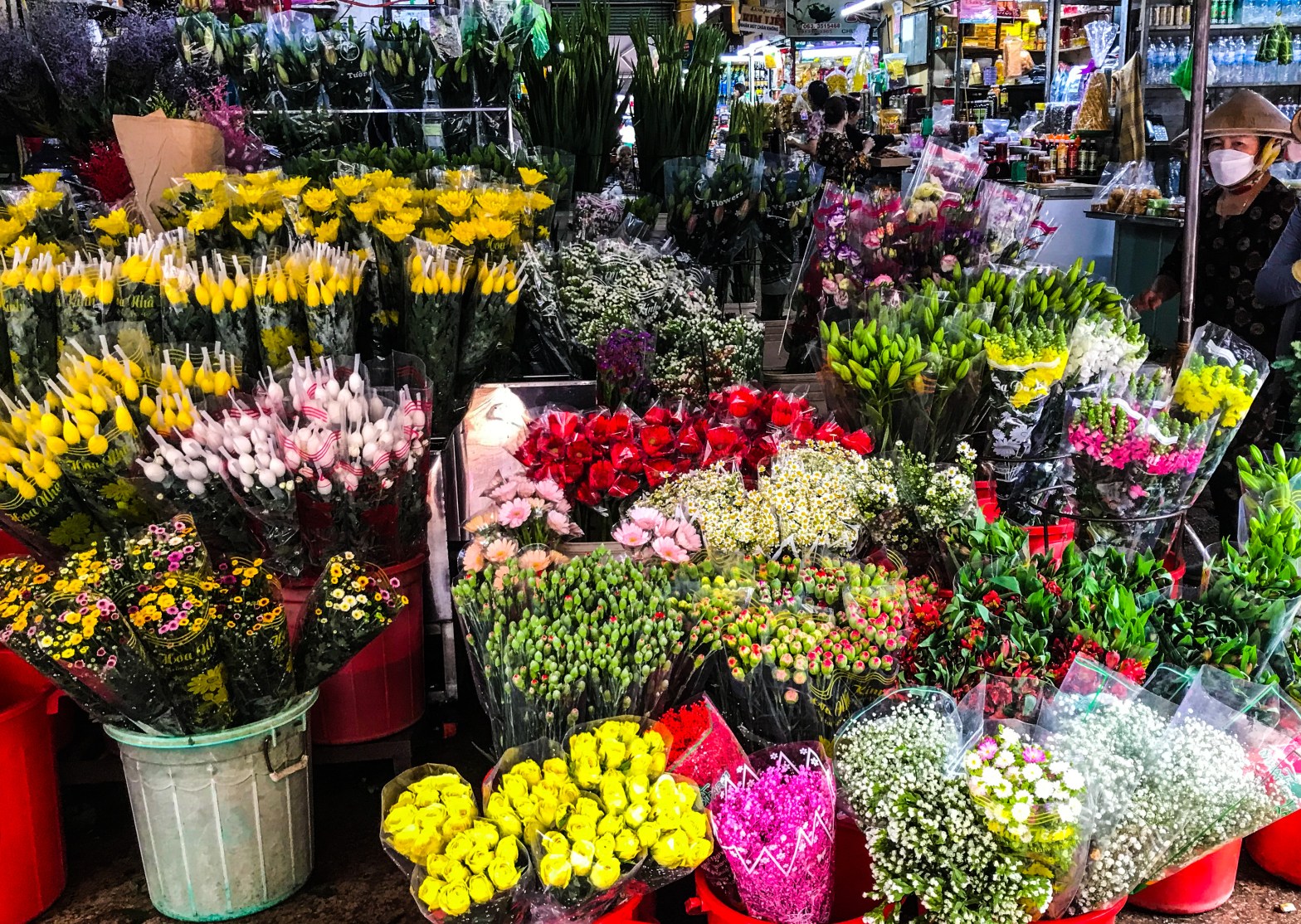
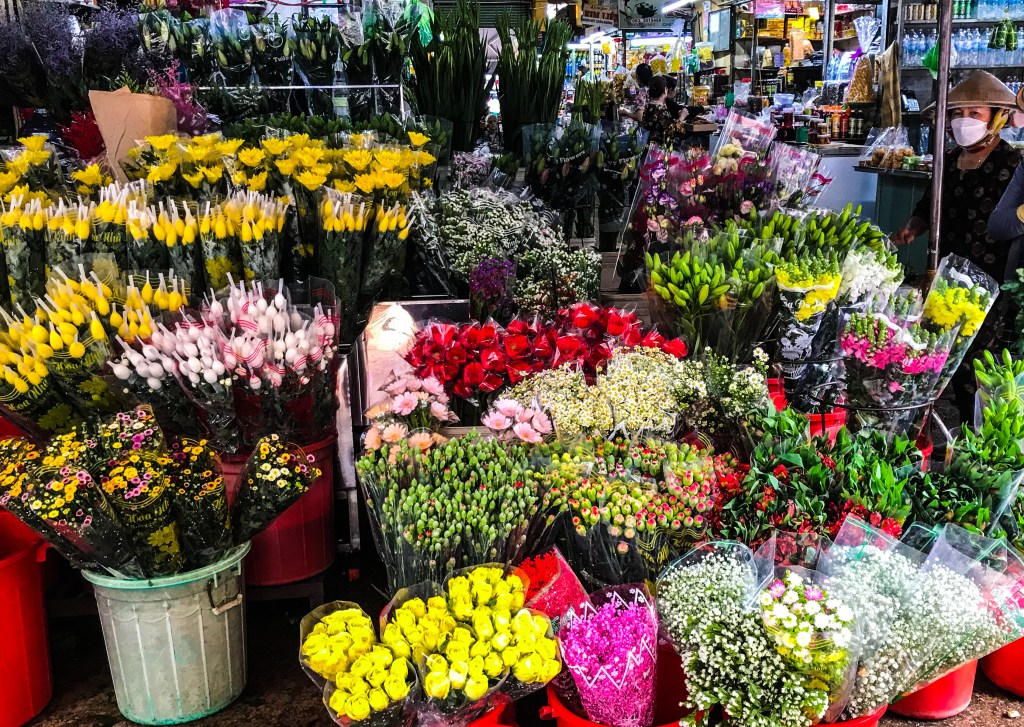
A better choice for market lovers might be Cho Da Lat in the heart of downtown. Each morning, the stalls are replenished with a new abundance of strawberries, avocadoes, durian fruit, and of course flowers by the thousands. Indeed, Da Lat likes to call itself the “city of eternal spring.”

A flower vendor at Cho Da Lat is immersed in color. (JGA photo)

Food and drink

The sweeping steps that rise above the central market area lead pedestrians to Hoa Binh Square, the focal point of a web of streets that wind away in every direction. Here are some of the city’s nicer mid-range hotels, restaurants and bars.

On Tru’ong Cóng Dinh street alone, eateries include Goc Ha Thanh, which makes a great Thai-style chicken curry; The Sky Over Da Lat vegetarian restaurant and gallery (try the cauliflower gratin pizza); and Mỹ Liên Từ’s carnivore-luring Aussie Burger bistro. Down the hill, at Artist Alley, on Phan Dinh Phung, accomplished painter Vo Trinh Bien hangs his oils and acrylics in the same upstairs room where ostrich steaks and grilled sea bass delight Western palates.

I would love to recommend Da Lat wines, but I cannot. It seems that most are sweet, high-potency varietals (as much as 17.5% alcohol) with a substantial blend of local mulberry juice. Wine lovers are better directed to Le Retour, a dedicated wine bar on Phan Boi Chau that specializes in European imports.

Eccentric decor and steep, narrow staircases are hallmarks of the Maze Bar. (JGA photo)

Amazing places

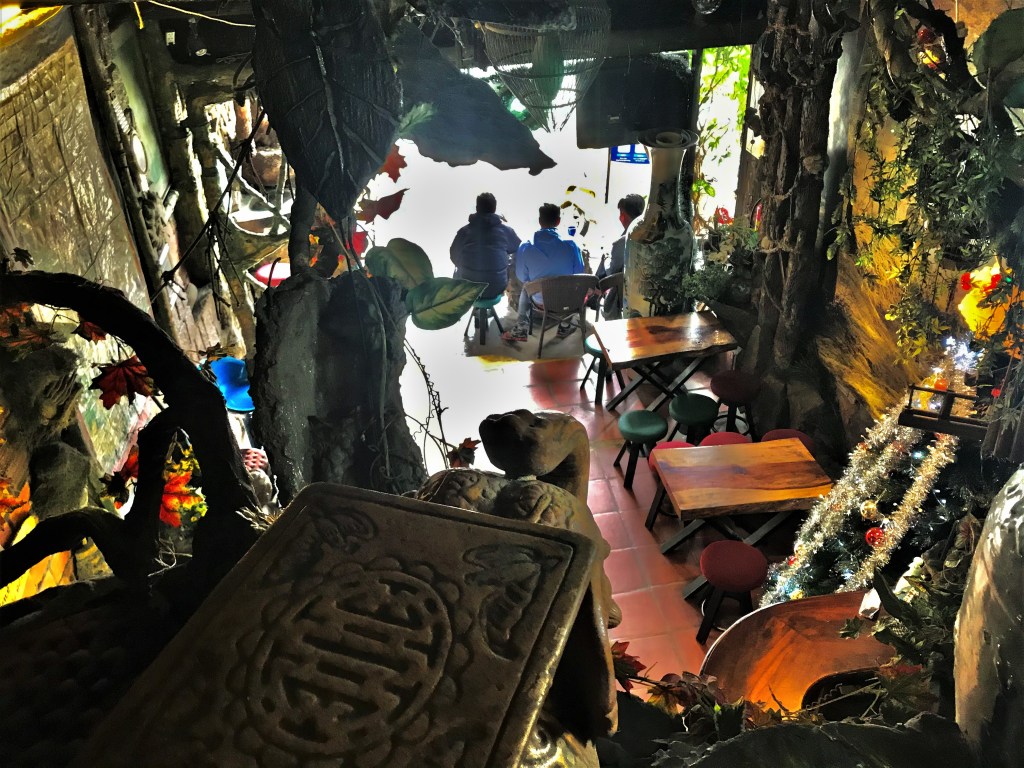
One establishment not to miss in this area is the Maze Bar, also known as “100 Roofs.” Coffee shop by day, bar by night, it’s a bohemian response to the Hang Nga Crazy House — like something out of The Hobbit. There are no jungle vines, no viaducts, but dark, narrow staircases that connect clandestine chambers conjure claustrophobia in even the most adventurous and level-headed visitors. Climbing five stories from basement to multiple rooftops, the watering hole is decorated with a trove of tribal antiques and collectibles from all over the world, adding even more mystery to its oddness.

Far saner is the DaLat Mountain View, a café and dessert stop that promises “coffee, joy, music” from its ridgetop outpost on the city’s east side. The view across the verdant highlands from the spacious deck draws throngs of young visitors for selfies and group photos framed by luxuriant foliage and luxurious hillside homes. And there’s nothing crazy about that.

A visitor to the DaLat Mountain View cafe enjoys the view from the deck. (JGA photo)

Next: The beach at Mui Ne

The Ocean Room at the Crazy House resembles an aquarium without water. (JGA photo)

Rooftop view at the Crazy House. (JGA photo)

18. A Visit to DaLat

A holiday in the Central Highlands yields delightfully cool temperatures, great street food, year-round flowers and a beautiful town-center lake.

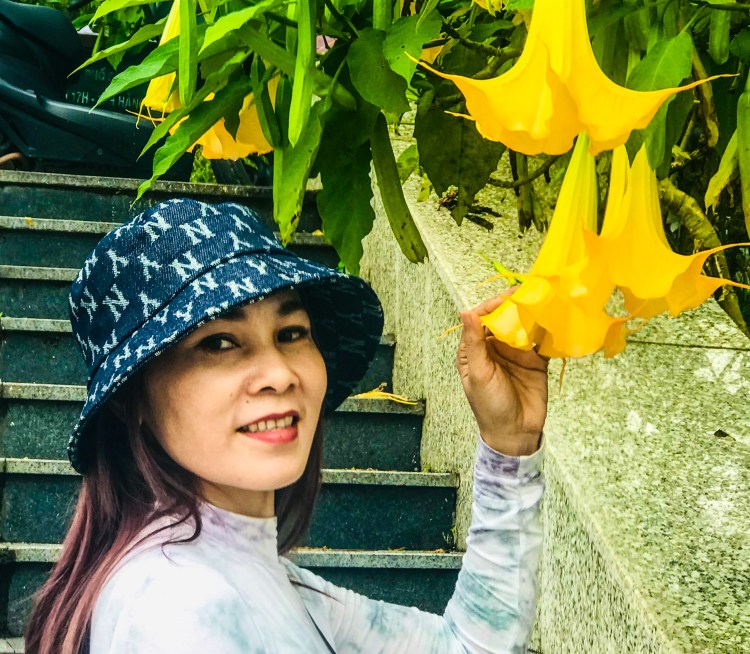
Lan Ha admires trumpet flowers in DaLat, the flower capital of Vietnam. (JGA photo)

Christmas doesn’t seem like a winter holiday when the weather is hot and muggy, as it almost always is in Ho Chi Minh City. A visit to DaLat offered a way to escape the heat, and a lot more.

This former French colonial hill town — its center rising like a citadel above the surrounding sprawl — sits at about 1,500 meters’ elevation in Vietnam’s Central Highlands, nearly 5,000 feet higher than sea-level Saigon. Eight hours on a bus, to travel 240 kilometers (150 miles), was a small price to pay for the reduction in heat.

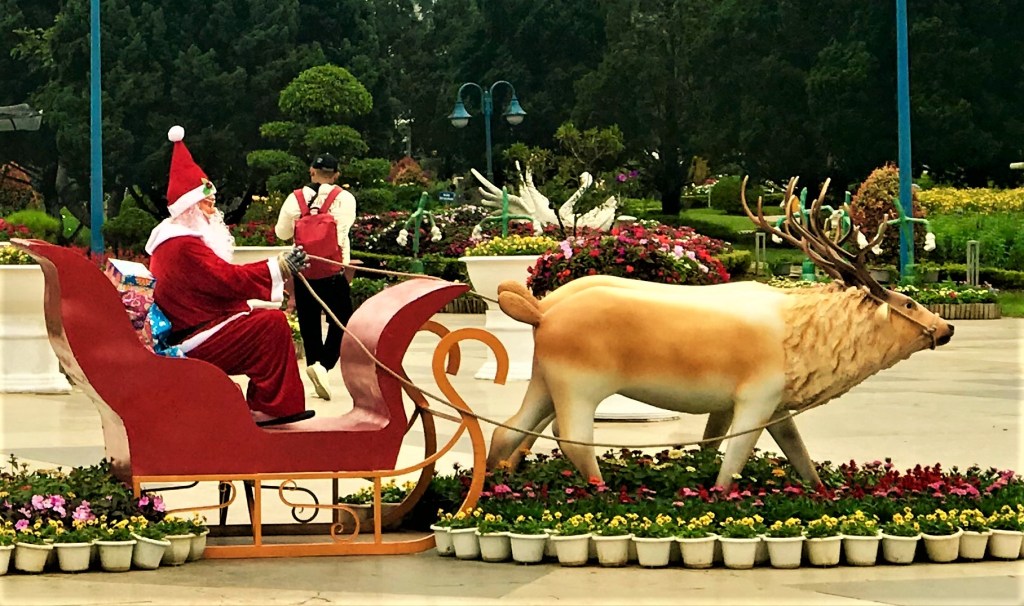
By the time I arrived at DaLat in the early evening, the thermometer had dipped from 84 degrees to 57 degrees Fahrenheit (14 Celsius). Townspeople were swaddled in downy parkas, gloves and wool hats. Santa’s sleigh, perched on a fountain in the central roundabout, didn’t look so out of place. But there was no danger of a white Christmas: No one could see their breaths.

The poinsettias didn’t have to be covered. Indeed, they were being sold in the public market, along with dozens of other kinds of flowers that, even now, were growing wild and in gardens throughout this provincial capital of 350,000.

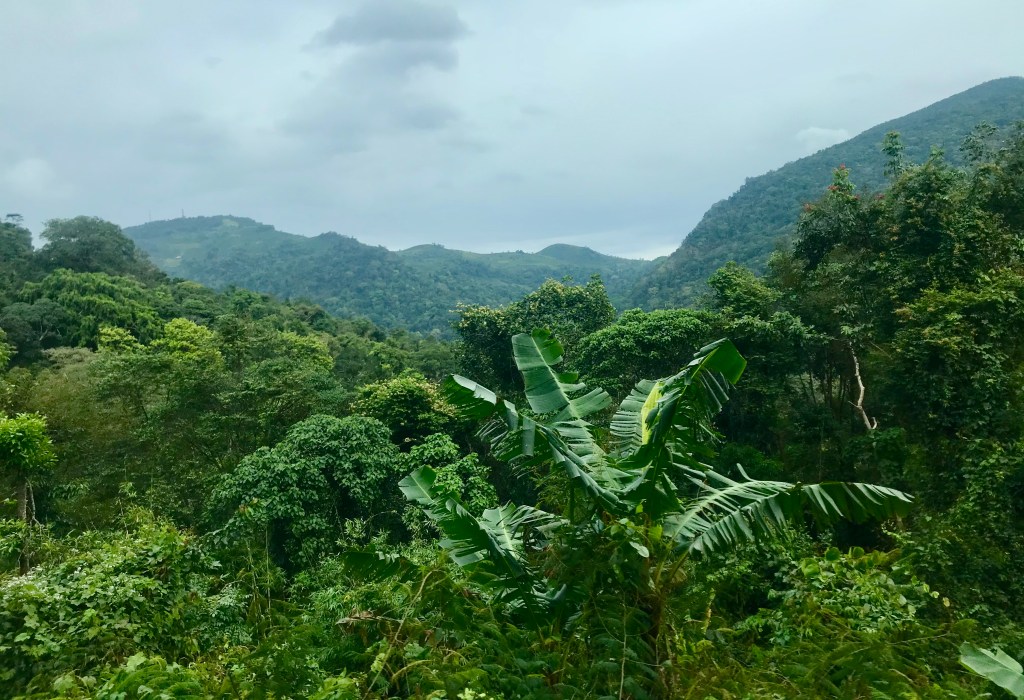
Mountains and jungle surround the highway near Bao Loc. (JGA photo)

A jungle out there

My bus from Saigon was a luxurious sleeper coach, with just 22 recliner seats well suited to overnight journeys. I may someday take advantage of that option, but for my first visit to DaLat, I was glad for the scenery.

The first couple of hours were decidedly urban as we crossed the wide Saigon River and proceeded through the modern industrial suburb of Bien Hoa. As Dong Nai province grew more rural, small farms became visible behind a single row of buildings that lined the highway. After the small town of Tan Phu, we began a steep climb through jungle-covered mountains to Bao Loc.

As we crossed into Lam Dong province, I looked out my window at a dozen different shades of green. The highway switch-backed around broadleaf foliage and sturdy trees draped head-to-toe with liana vines. I could imagine monkeys, colorful birds, snakes and other wildlife, perhaps even rare tigers, that might be hiding here.

In the wink of an eye, we climbed the last hill, left the jungle and emerged on a street where coffee was king. Every home in Bao Loc, it seemed, had fresh coffee beans — olive green, chocolate brown and blond — spread to dry on blankets in their yards.

Street vendors offer skewered meats on a cold night. (JGA photo)

Street eats

A picturesque two-hour ridgeline drive ended at my hotel in DaLat.  (My booking at a budget inn called Khánh Hân was so disappointing that I moved the next day to the Phu’ong Vy boutique hotel. This was superior in every way, at the hardly exorbitant nightly cost of US$13).

I was just in time for dinner. In the town center, a street market on Nguyen Thi Minh Khai was drawing a large Monday night crowd. Several women, dressed for the wintery weather, were hawking skewered meats, which they barbecued over sizzling coals as I sat with a Tiger beer. The chicken and beef sticks were good, but the baby squid and okra combination was exquisite.

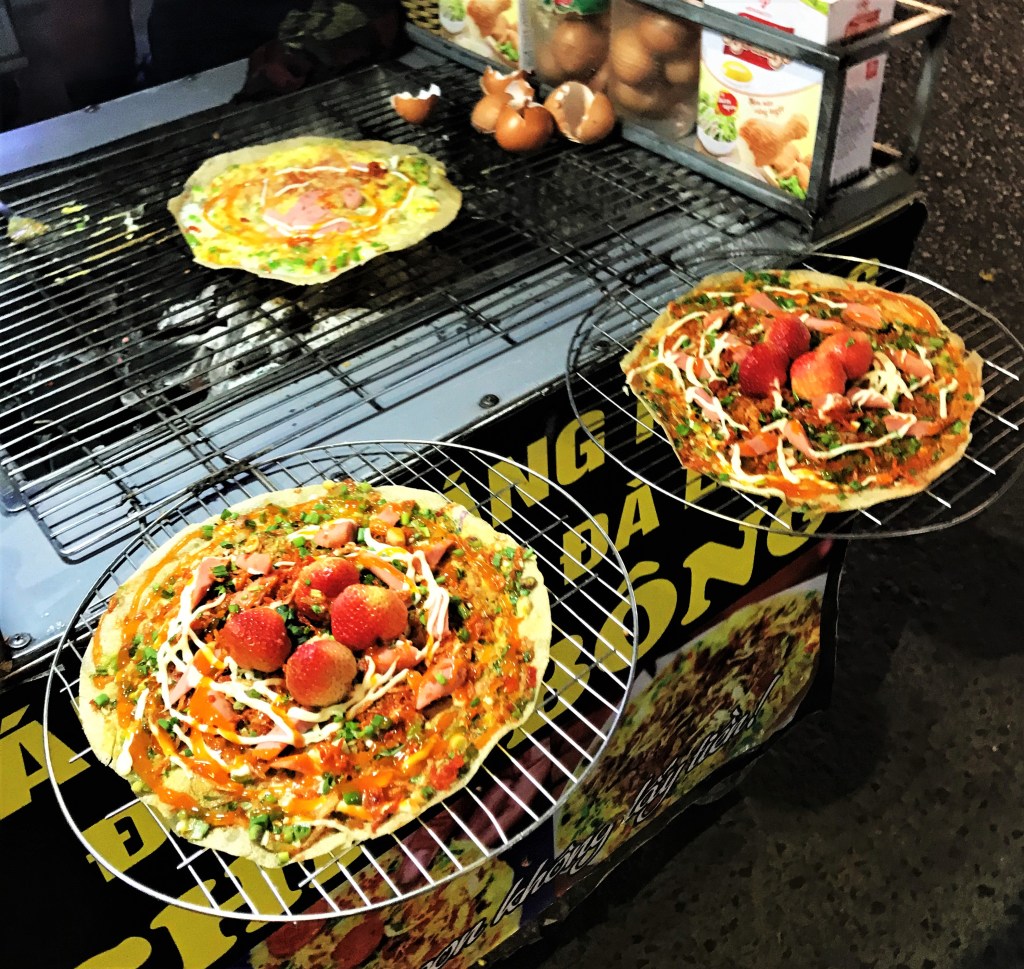
Further down the row, a young man had his own mobile street-food café at which he offered bánh tráng nướng, otherwise known as “Da Lat pizza.” Instead of wheaten dough, he used several layers of rice paper, topped with a beaten egg to prevent burning, then grilled on a hibachi. Cream cheese, mayonnaise, chili sauce, spring onions and other ingredients, including locally made sausage, were added as it cooked. I especially liked the strawberry flair at the finish, but I think avocadoes, another popular local product, might have been more complementary.

DaLat “pizza” is a local specialty. (JGA photo)

Like a banana moon

As a mountain-town boy living in the Ho Chi Minh City megalopolis, one of the things that I miss most is having places to walk where there’s no traffic to dodge. Even circuits of the big city parks, where many choose to exercise, aren’t appealing to me.

I loved walking in DaLat, especially around Hồ (lake) Xuân Hương. It’s in the heart of town, entirely fringed by a park strip. Some say this reservoir is shaped like a crescent moon, others like a banana; I suppose they’re both right. On my first morning, I easily covered the 5-kilometers (3.2-mile) circumference in a casual two-hour stroll, with plenty of time for photographs.

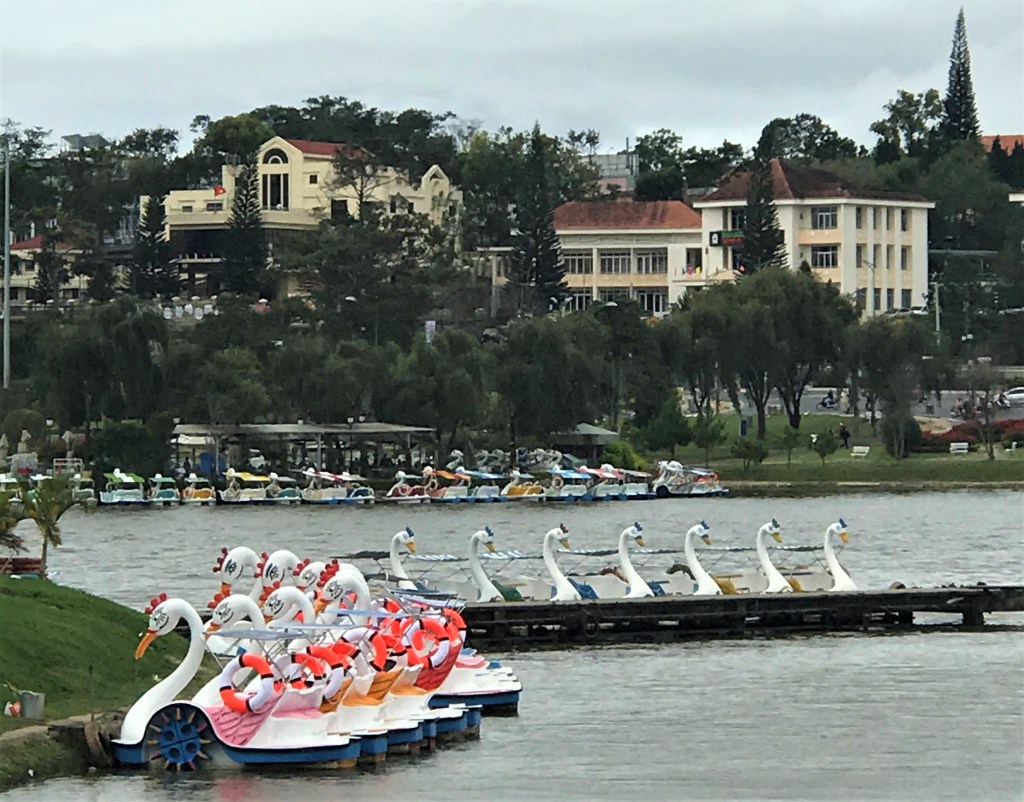
My initial destination was the DaLat Flower Garden, on the north shore furthest from the city center. En route, I paused at a purple-painted lakefront café, where I enjoyed a cup of local coffee; a tiny marina, where paddleboats disguised as giant swans attracted parents visiting with young children; and a depot for ornate horse-drawn carriages that could have been extras in Disney’s Cinderella.

There were swans on the lake, but no “nutcracker.” (JGA photo)

Floral wonders

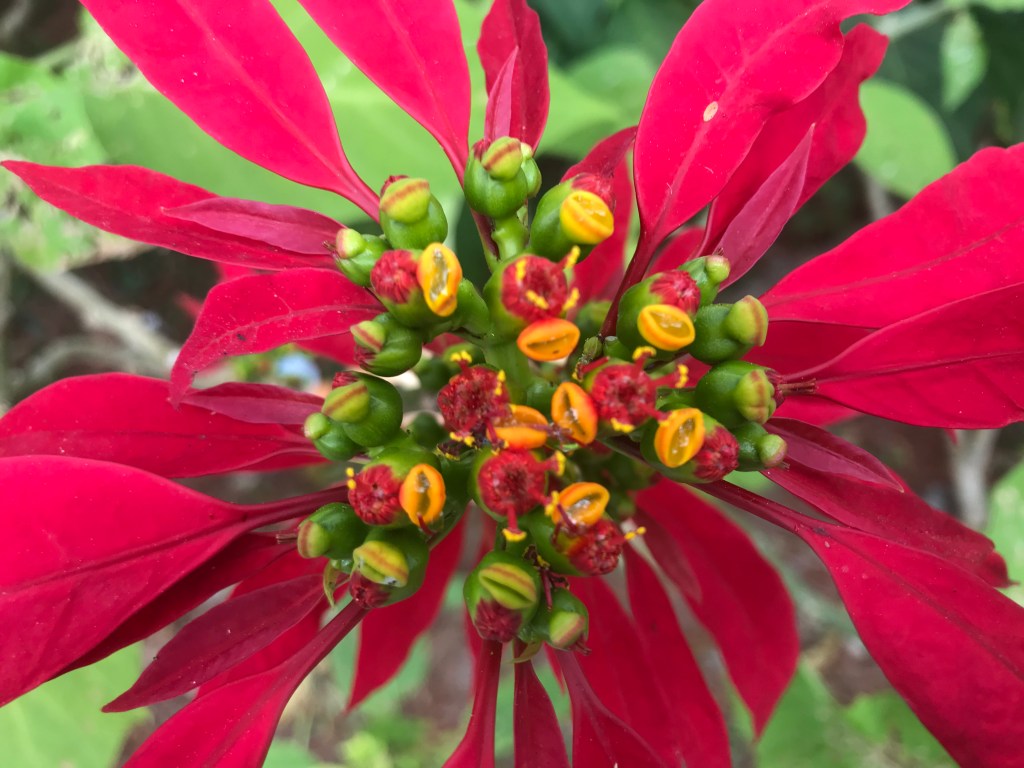
But I was grateful to use my own horsepower. And as I ambled, I was astounded by the botanical wonders lining this promenade. I passed white and orange trumpet flowers, pink and red hibiscus, jacaranda, mimosa and poinsettias. There were anthurium, ginger, morning glory, hydrangea and crepe myrtle.

Tiny, delicate blossoms peeked from quiet garden corners and flamboyant garlands draped from trees. There were red flowers, purple flowers, yellow flowers, pink flowers, more than I could put names to.  The Flower Garden was an anticlimax, a few beds of carefully tended fuchsias and orchids amidst seasonal kitsch such as Santa and reindeer.

Poinsettias grow wild along the streets of DaLat. (JGA photo)

I turned at the head of the lake and followed the south shore back toward the town center, passing en route an inconspicuous pagoda, a public market (where I purchased a stock of fresh roasted cashews and dried apricots), and the DaLat Opera House (more on which in my next blog). Along the fertile shoreline, hobby fishermen pulled in catches of what, to my untrained eye, appeared to be carp, as white cattle egrets stared on hungrily.

And to think: I had not even spent 24 hours yet in DaLat. What would tomorrow bring?  Indeed, what was ahead for the afternoon?

DaLat’s town center rises like a citadel above its surroundings. (JGA photo)
Local flowers are always for sale in DaLat’s public market. (JGA photo)

Next: Crazy? Who’s crazy?

17. Christmas in Vietnam

Although its Christian population is relatively small, Vietnam is all about wishing you a merry Christmas.

Santa tramples the blossoms in the Da Lat Flower Garden. (JGA photo)

He knows when you are sleeping. He knows when you’re awake.

No, I’m not talking about the Vietnamese government. I’m talking about Santa Claus. It seems everywhere I look this days, I see some version of the jolly old soul, with or without reindeer, inviting the people of this Southeast Asian country to join in the Christmas spirit.

Never mind that fewer than 10% of Vietnam’s people are Christian. I suspect that not many people here associate the holiday with the birth of Jesus. But that doesn’t stop the masses from singing non-sectarian seasonal songs (Taylor Swift’s cover of Wham!’s “Last Christmas” is a favorite), spending small fortunes to decorate their Christmas trees, or visiting with Santa himself in urban department stores.

Holiday spirit

Chúc Giáng Sinh (“Merry Christmas”)! As a resident Westerner, I do find a hint of home in the banners draped across hotels and restaurants that depend upon expatriate business. I’ve been listening to holiday music since mid-November.

But unlike the West, there’s no halt in day-to-day activities during the Christmas period. Some commercial offices, especially those that employ foreigners, may find time for holiday parties, but there are no days off. Business continues as usual. Ditto public schools, where students are preparing for end-of-the-calendar-year examinations.

As far as most of Vietnam is concerned, the new year begins not on January 1, but with the Lunar New Year, which in 2021 falls on February 12. That’s when everyday life comes to a complete halt for a week, when urbanites return to their “hometowns” to visit family and friends.

A holiday sign at the Cha Tam church in Saigon’s Cholon district (JGA photo)

Catholic legacy

Of Vietnam’s 9 million Christians, a majority live in the southern part of the country, near Ho Chi Minh City (Saigon). About 80% of them are Roman Catholic, a legacy of Jesuits and other missionaries — French, Italian, Portuguese, Spanish — who began visiting in the 16th century. The written Vietnamese language (with its diacritical marks) owes its very existence to these emissaries of the Pope.

During the “American” War of 1954-75, a great many Vietnamese Catholics fled persecution in Marxist North Vietnam for the shelter of South Vietnam, where archbishop Ngo Dinh Thuc just happened to be the brother of republican president Ngo Dinh Diem. Today, there’s a great deal more religious freedom. In fact, Vietnam’s government has semi-normalized its ties with the Vatican, unlike China and other communist countries of Asia.

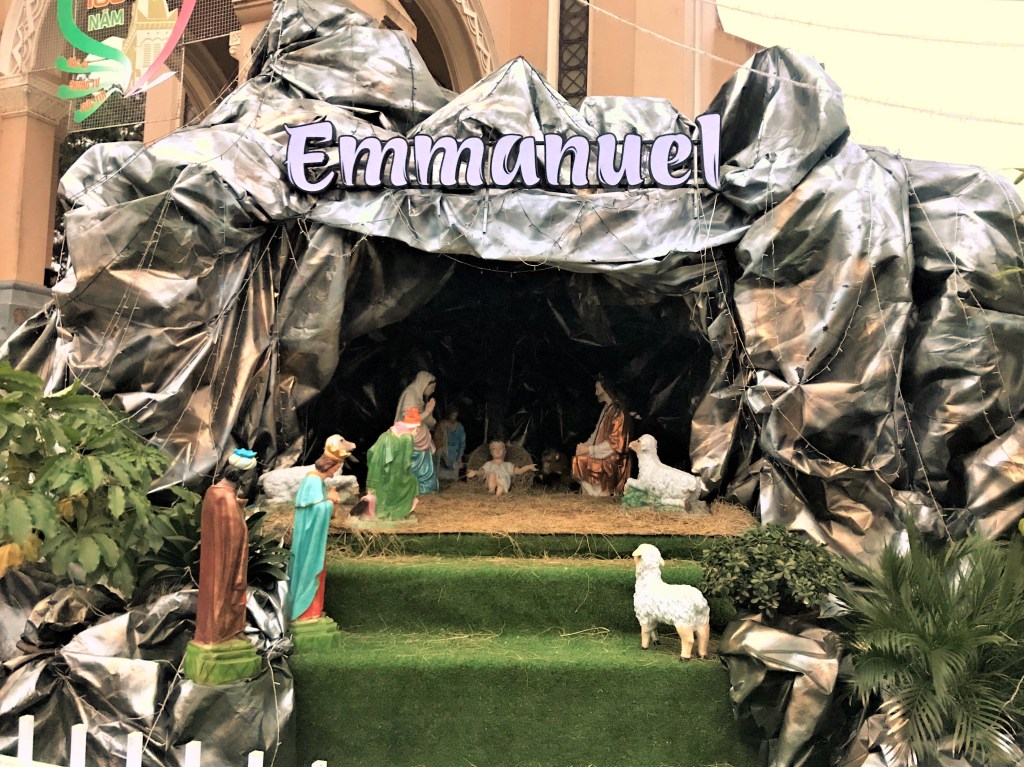
Nativity grotto at Dalat Cathedral (JGA photo)

The churches, of course, celebrate the birth of Christ with choral events, Christmas Eve masses and other activities. In Vietnam, they also invariably build grottos in the form of mangers. Blankets, aluminum foil, perhaps papier mâché and other materials, are used to fashion these crude constuctions both indoors and out, with nativity scenes carefully constructed within them. They remind me of the Stations of the Cross — without the stations.

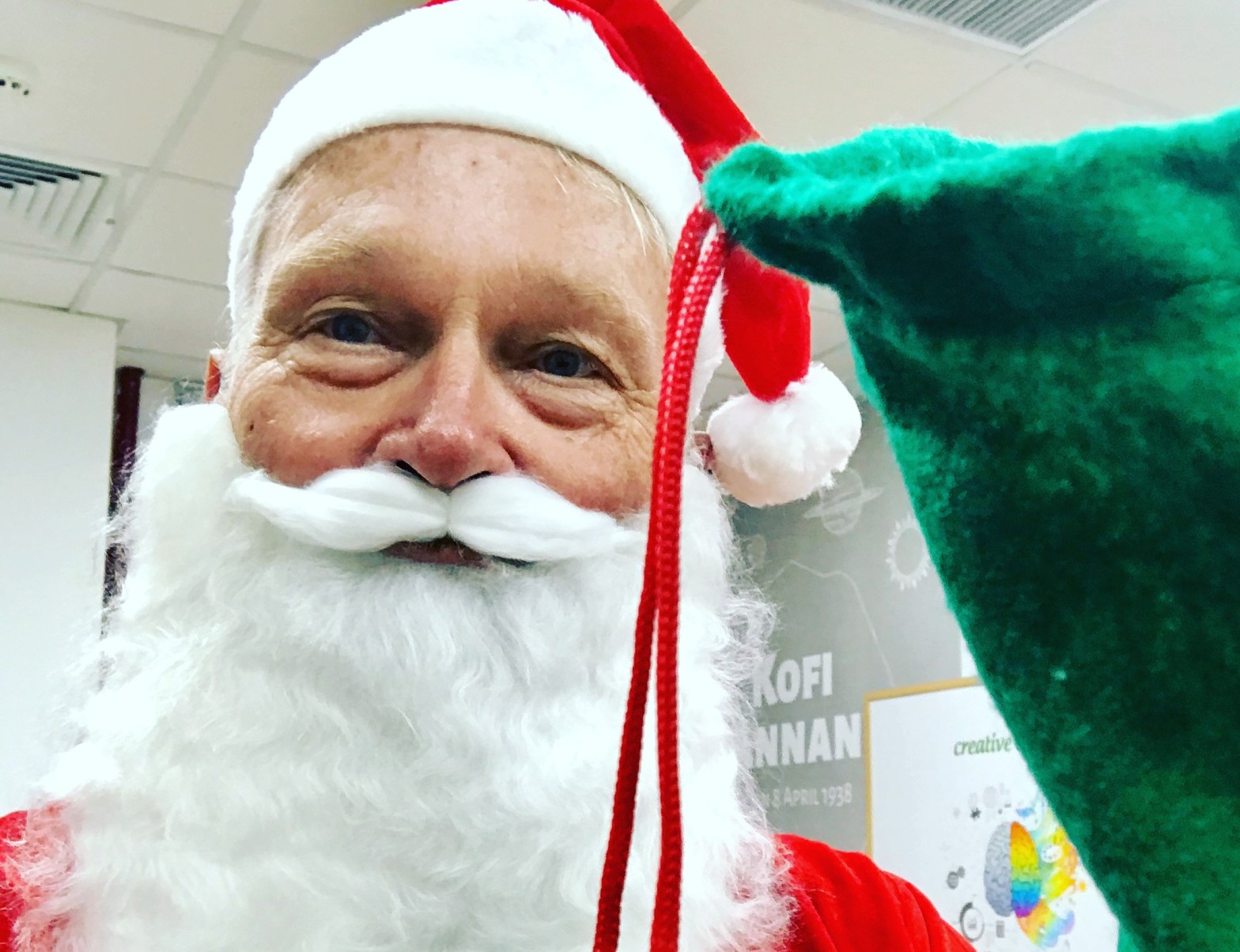
Ho ho ho! (not a selfie)

And yes, this Santa is yours truly in disguise. Please allow me to wish all of my friends, family and dedicated followers around the world the very best for the holiday season. It’s a new year in 2021, and for all the changes that 2020 has wrought, we can be excited about positive changes in the months ahead.

Next: A visit to Da Lat

16. In the Time of Corona

In this late 2020 blog, the author praised Vietnam for its record of remarkable success against COVID-19. The following year, the situation reversed itself dramatically.

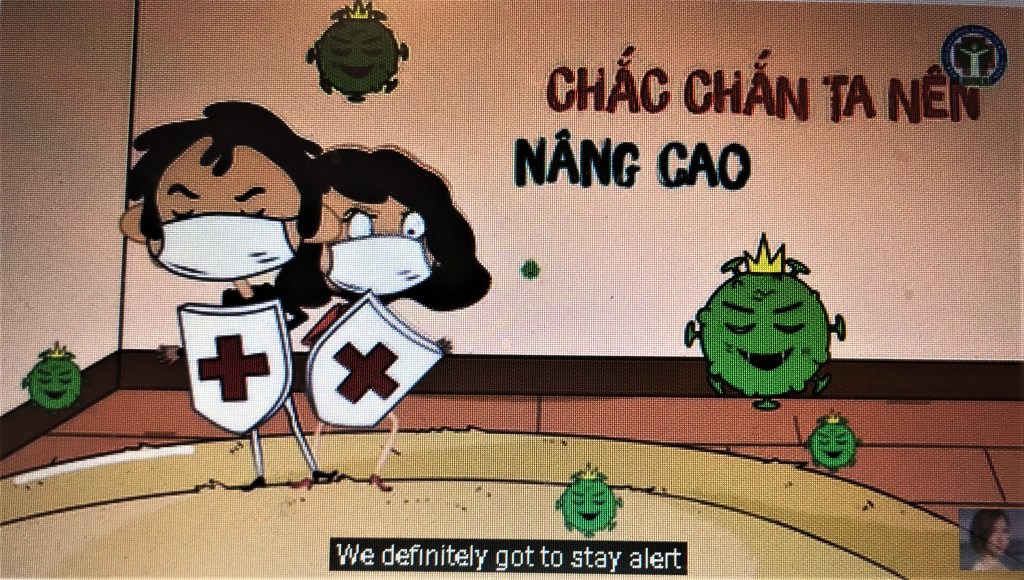
Frame from a public-service TV commercial in Vietnam

In this landmark year of 2020, North American friends have asked me no question more often than: “What’s going on with COVID in Vietnam?”

As a matter of fact, there is probably nowhere in the world that I would rather be.

In sharp contrast to most Western nations, Vietnam has been in almost complete control of the spread of COVID-19, the coronavirus pandemic, since the first case was detected here on March 6.

The following statistics — current as of December 18 — underscore the country’s success.

Vietnam population: 97.7 million. Total cases: 1,407. Total deaths: 35 (none since September 3). Active cases: 109.

Contrast this to the United States, which has far and away the worst COVID record in the world. US population: 332 million. Total cases: 17.6 million. Total deaths: 318,000. Active cases: 7 million.

For every million people who live in Vietnam, 14 have contracted the disease, and 0.4 have died. For every million people who live in the US, 53,100 have been diagnosed with COVID-19, and 958 have died. The rate of infection in the US is 2,400 times greater than in Vietnam.

In Vietnam, the average number of new cases per day, since March, is five. In the United States, the average number of daily new cases during that same time period is 61,000. Daily new cases are now approaching a quarter of a million.

It is a shocking disparity.

Cautionary poster emphasizes face mask use

Do as you are told

How can a country that is considered a world leader in the field of medicine be such an utter failure at managing a deadly disease, when a Third World nation has such success? Without pointing a finger at political mismanagement in the US, here’s my interpretation.

First, Vietnam’s government is authoritarian, not democratic. It’s a one-party, communist system. When you’re told to do something, you do it. A higher power makes the decisions for you. There may be some minor acts of personal rebellion, but heavy fines and possible imprisonment await those who try to assert their rights as individuals, especially if they are counter to the political line. Communism advocates the belief that “We’re all in this together.”

Secondly, the Vietnamese people are used to wearing face masks. Especially in Ho Chi Minh (Saigon) and Ha Noi, where most citizens ride exhaust-spewing motorbikes, and where air pollution is a health hazard in itself, it is de rigueur to breathe through a filter on the city streets and highways. When the federal government mandated that masks be worn at all times, no one questioned the ruling.

Although this is a communist society, it is also, beyond question, a capitalistic one. People like to make money. So in March, when the severity of the first wave of COVID became apparent, an order to close all but the most essential businesses was met with shock and consternation.

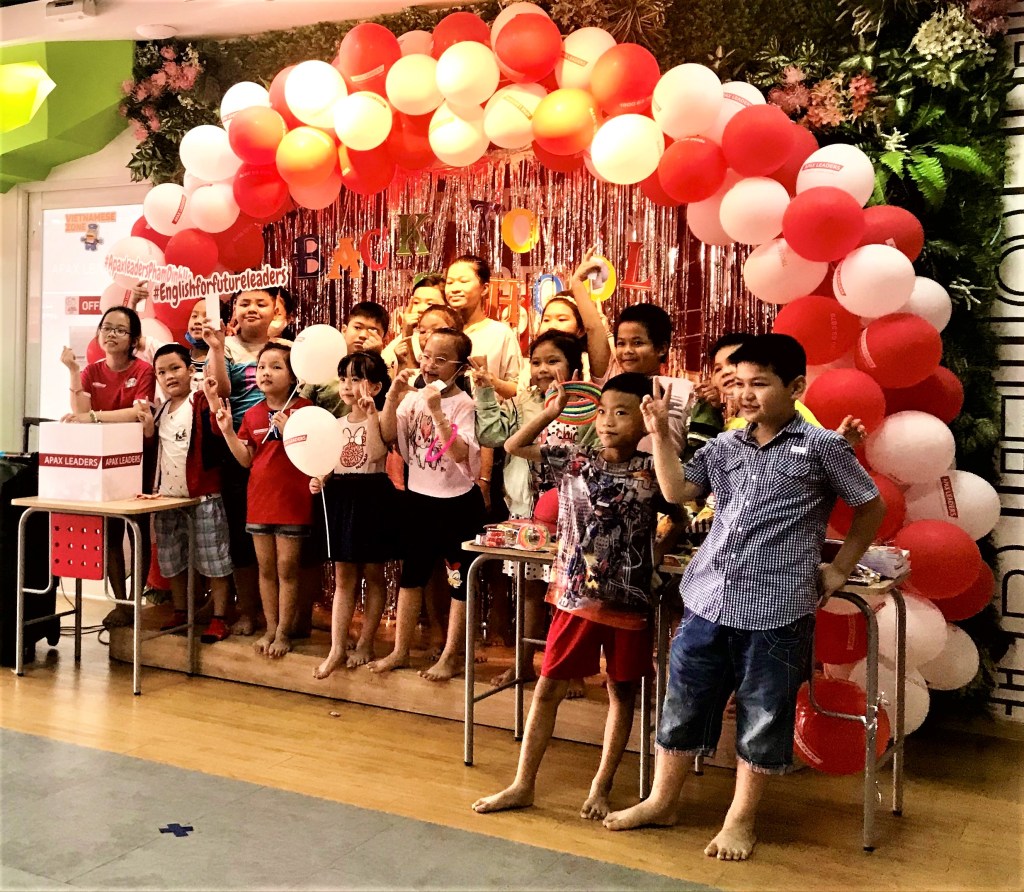
Initially, this focused on places where people gather in close proximity — bars, restaurants, coffee shops and retail merchants. Soon, public transportation was shut down as well. Government schools were closed and private academies, such as my own, were told to do the same. (APAX Leaders, where I work, transitioned to online instruction within a week thereafter.)

Hospitals, pharmacies and major groceries remained open with skeleton staffs. Virtually everyone else in the country went into self-quarantine. We stayed at home. Once a week, I walked three blocks to the supermarket, where I had to pass a security screening (temperature taken, hands scrubbed with disinfectant) before I could do my shopping. I cooked at home, worked online, and read a lot.

TV commercial spot: Wash your hands!

Invasion of privacy

By mid-April, the initial threat had mostly waned without a single death. Then, in the latter part of July, there was a second, harsher wave, traced to a handful of illegal immigrants in the resort city of Da Nang. All of the country’s deaths occurred during this period. If COVID were going to truly surge in Vietnam, this is when it would have happened. It didn’t.

A good part of Vietnam’s success might be credited to “contact tracing.” As soon as a corona victim is identified, he or she is relentlessly grilled to determine any and all of their contacts in the two weeks prior.

The information is then published. That includes names, residential addresses (to alert the neighborhood), and businesses they are known to have visited — stores, restaurants, gyms where they may work out, karaoke bars where they may take the microphone.

Is this an invasion of privacy? Absolutely! It would not go down well in Western democracies, where individual freedoms are more highly valued than society as a whole. But it’s hard to argue with success, at least in this case.

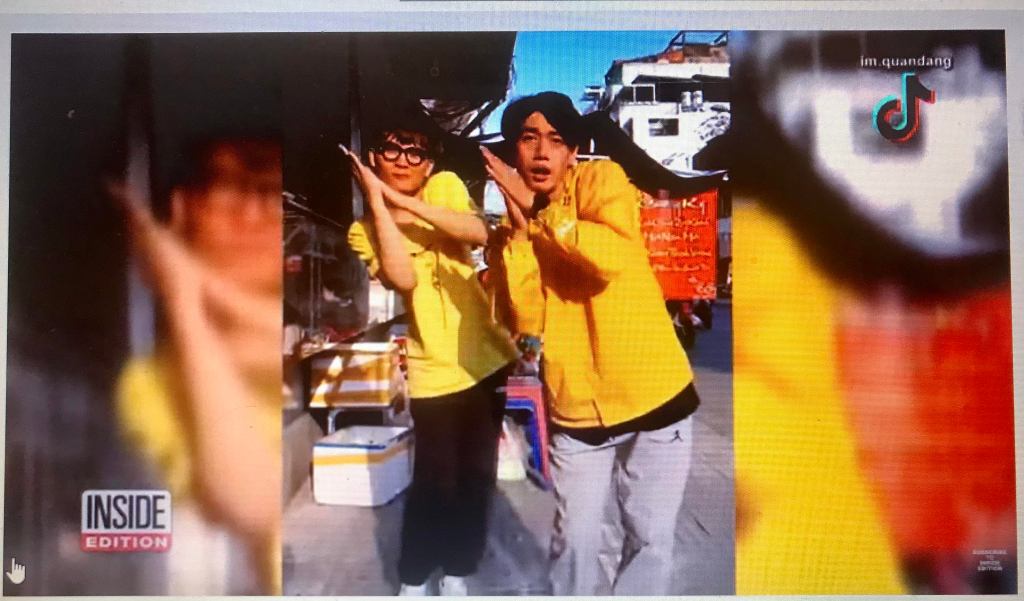
COVID dancer Quang Dong goes viral

Feeling the bite

Even in this safe place, a great many Vietnamese remain terrified by the implications of COVID-19. There remains some fear of domestic travel, even to areas with no history of this flu. Restaurant and bar business continues to suffer. And in my classrooms, I still hear, “I wear a mask because of COVID.” Whenever anyone coughs or sneezes, an alarm flag is raised.

Ad campaigns have contributed to the heightened awareness. Early in the COVID era, a public-service television commercial with a catchy jingle reminded viewers to wear masks and wash their hands assiduously. When a Saigon dance choreographer produced a video and uploaded it to TikTok, it became a viral (no pun intended) sensation. And everywhere, there continue to be billboards and print advertisements reminding the public to keep vigilant.

Few segments of the national economy have been affected as much as the travel industry. Because airports were quickly determined to be the biggest offenders, where the virus entered the country, Vietnam suspended inbound international flights as early as March 25. That effectively put a temporary end to tourism.

In September, some flights to selected Asian countries — including China, Japan, Korea, Taiwan and Singapore — resumed. But incoming passengers are still required to spend two weeks in quarantine (either in a private home or a hotel) until they can again freely mix in public.

Now, with vaccines about to become available, the country is again promoting tourism for 2021. A new ad campaign by Vietnam Tourism — Why Not Vietnam? | Vietnam Tourism — highlights many of this nation’s stunning attractions.

And that’s a subtle invitation to my friends around the world to come visit.

Keep the pandemic from exploding!

*A mid-2023 postscript: This report was written in December 2020. Through June 2021, Vietnam had reported a total of 28,000 cases of Covid-19. Then the Delta variant arrived, and the situation turned on its head. Within 10 months, cases had passed 11 million. The worst was contained by September 2022. As of June 2023, total cases in Vietnam are 11.6 million, about 12 percent of the population, with the death total 43,206.

Next: Christmas in Ho Chi Minh City

15. Kindergarten Pop

English teaching is big business in Vietnam, where it seems everyone wants to learn the world’s most widely spoken language. But it can be a challenge for a novice instructor.

Kindergarten-age students in a teaching environment. (JGA photo)

Anyone who thinks teaching 4- and 5-year-olds is easier than lecturing to 20-year-old university students obviously has never spent much time around young children.

When I committed to an English-teaching job in Vietnam, I did so with the naivety of a jellyfish. I hadn’t planned on teaching at the kindergarten level, but if that were to be my temporary destiny, I figured the kids would all be like Sponge Bob. They would simply absorb the new language as I showed them pictures and drilled the vocabulary.

Guess again. Every one of these kids has a personality as unique as my brother, my sister and I. Who knew? There may be a couple of sponges in each class of 10 to 12 students, but every day I find myself wrestling with tears, misbehavior, clinginess, hyperactivity and attention deficit (big time). Some children won’t let go of stuffed animals. Others don’t want to lose sight of Mommy.

Thankfully, I am assisted at the younger levels by bilingual Vietnamese teaching assistants, young men and women with some expertise at soothing childhood anxiety.

Classes are 90 minutes, twice a week. I regularly devote a large part of that block — 30 minutes or more — to short videos, singing, and arts-and-crafts activities. I learned quickly that I must entertain as well as educate, to maintain any level of attention.

Young “Ryan” puts the finishing touches on a picture of Picachu. (JGA photo)

Learning phonics

The course material provided by APAX Leaders, my parent English education company, is very phonics-oriented. The most basic level (“Cocoon”) starts with learning the alphabet: “Letter ‘A’ sounds like ‘ah.’ Letter ‘B’ sounds like ‘bah.’” It’s easy to confuse the sounds of “b” and “p,” of “d” and “t.” And how do I explain that “C” can sounds like either “k” or “s”?

Some of the quietest kids are the ones who grasp the material most quickly. Some of the loudest kids have the greatest struggles with phonics. I don’t want to say they seem hopeless, but, well, take Sarah, for instance. Please, take her. She is an impudent little princess, but after several months in class, she still can’t recite a letter. Yet impish Ben and teeny, tiny Mimi have the right answers nearly every time.

Yes, the children are encouraged to take common English names. Most of the choices are American or British. But in my various classes, I have girls who go by Sky, Pink, Mori and Xuka, and boys named Coco, Jindo and Yasuo. Food names are popular: Strawberry, Sushi, Cherry, Mint, Candy and Apple. So are superheroes and their ilk: Spiderman, Conan, Sonic.

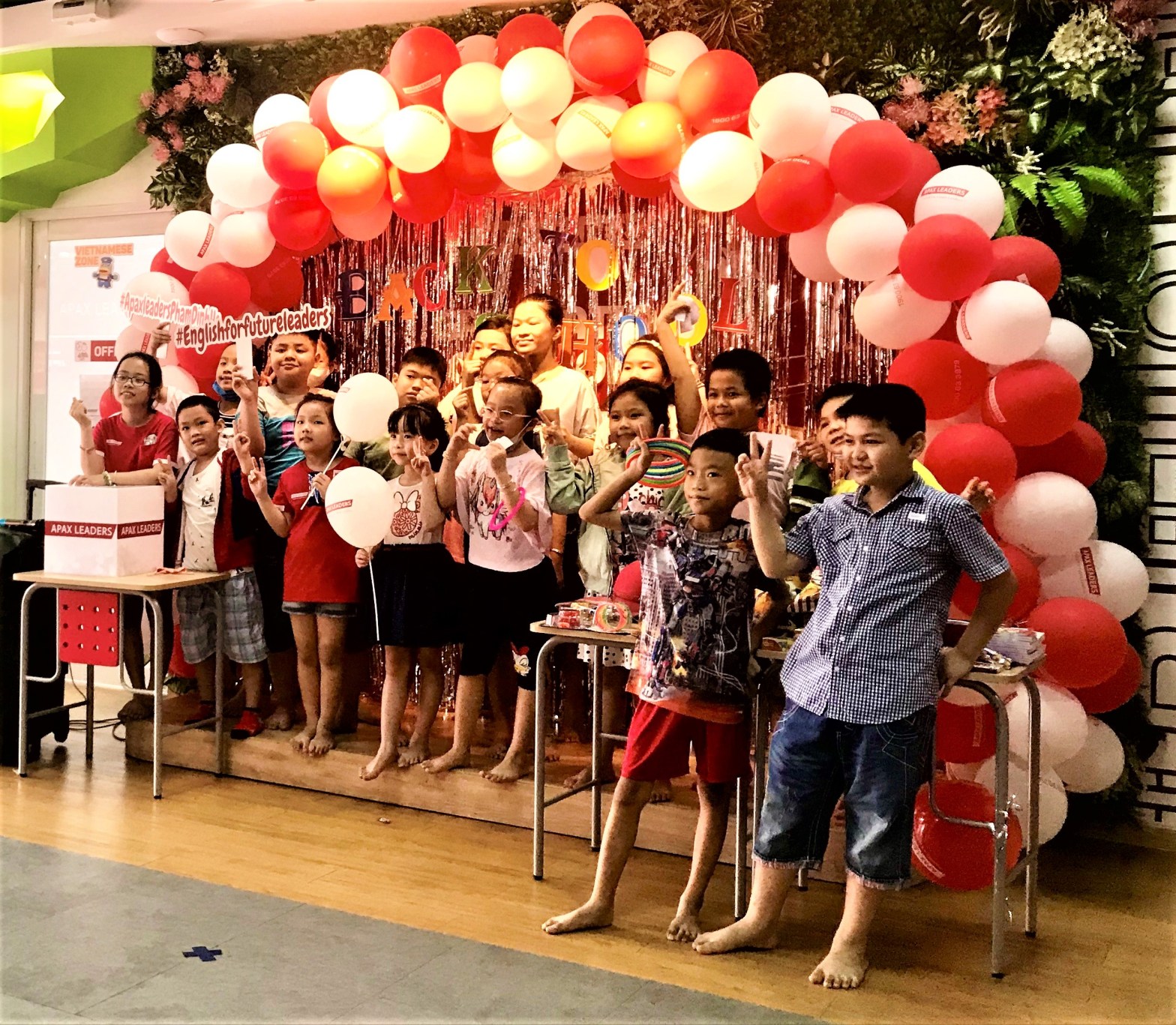
The front desk staff at APAX Leaders, Pham Dinh Ho, District 6 (JGA photo)

Moving up

Now, not all of my students at APAX Leaders are this young. Indeed, my classes span all age categories up to about 15. The youngest, after progressing through two levels of Cocoon, move up to Caterpillar and Butterfly. The older students, most of them at least 8 years old, progress through the levels of Seedbed, Seed, Sprout and Sapling as their knowledge expands and their fluency improves.

As a teacher, I emphasize listening, speaking, reading and writing. A typical lesson will begin with vocabulary review, followed by the recitation of a picture story. Next comes a series of questions designed to test comprehension of the material. It’s easy to tell who listens and who doesn’t.

 Among the older kids, in classes that top out at 16 in number, talking is the biggest disciplinary problem. Our first classroom rule is “Speak English!” and many youngsters gradually learn to adhere. But there are exceptions to every rule. When my irritating toy bicycle horn fails to produce a degree of silence, I have a booming voice: “Be quiet!” may shortly be followed by “Shut up!”

10-to-12-year-olds in Seedbed class (JGA photo)

Prep and progress

There’s a substantial amount of “prep” (class preparation) that goes on for an hour or so before classes begin.  At the conclusion of every three- to four-week unit, I use a tablet to video the class, creating short movies for parents to observe their children’s progress.  (I like to ask the students, “How are you?” One girl responded, “I’m fucking great!”)

And several times a year, I write individual critiques of each of the kids whom I instruct.

This has been the general program since I began teaching English at the end of December last year. For about six weeks in March and April, when fear of the corona virus crested in Vietnam, I stayed home and conducted online classes via Zoom.

That was sufficient but far from ideal. My shouts of “Be quiet!” were much fewer in number, but online teaching did not provide a practical method of drilling and follow-up.

I’ll talk about the virus (COVID-19) and its impact on Vietnam in my next blog.

APAX Leaders, Pham Dinh Ho, District 6, Ho Chi Minh City (JGA photo)

Next: Here comes COVID-19

14. The Sacred and the Profane

A celebration of the Tet holiday, in a Mekong Delta village, is a magical mystery tour of Buddhist spirituality, drinking games, unthinkable foods and cockfights.

Kurt Bennett at the Quoi An pagoda on the eve of Tet (JGA photo)

Years ago, when I was a student of world religions, required reading was a book called The Sacred and the Profane. In his work, author Mircea Eliade compared and contrasted the serenity and devotion of a spiritual practice with the chaos of non-religious activities.

I couldn’t help but reflect on that volume during my few days in Quới Ân. In this tiny Mekong Delta fishing village, in a very real sense, I experienced extremes of both.

The acrid smell of burning incense drew Kurt, Thi and I into the village pagoda early on the eve of the Tet new year, which in 2020 fell on January 25. Within the shrine, we were captured by the seductive scent of two Đầu lân (“cannonball”) trees, their riotous, crimson-and-yellow blossoms dangling between the beige pods that give the plant its English name.

Đầu lân (“cannonball”) tree at Quoi An pagoda (JGA photo)

A padded gong gently announced our arrival to a young priest, whose face lit into a broad smile as Kurt and Thi approached. Kurt embraced his wife’s Buddhist faith when they were married. His annual returns to his wife’s hometown are met with anticipation not only by the immediate family, but by the greater Quới Ân community, as well. (I had already grown accustomed to him wishing “Chúc Mừng Năm Mới,” “Happy New Year,” to everyone we passed as we walked.)

A young monk accepts envelope offerings at Quoi An pagoda (JGA photo)

The monk was grateful for temple-goers’ offerings, each gift discreetly hidden in a holiday-red envelope. The pagoda’s upkeep and maintenance, as well as the holy man’s own spartan quarters, are reliant upon community support.

Temple offerings

I followed Kurt and Thi as they visited each room of the sanctuary, occasionally pausing to pray at colorful altars and austere memorials, some of them framed in Chinese characters. “If my wife says it will assure me a better after-life, I’m all for it,” said Kurt, a large man raised in a blue-collar family in Oregon.

Kurt and Thi offer prayers at the pagoda (JGA photo)

Offerings of fruit, flowers and incense adorned altars to the Sakyamuni Buddha, often protected by icons of fierce warriors. The many-armed goddess of mercy, Quan Am, had a central place of respect. Against one wall stood an antique bronze bell, its bench and hammer confirming that it was often in use.

Outside were whimsical animal images, including an Easter Bunny look-alike cavorting with fat, laughing Buddha sculptures in the garden. In a kitchen at the rear of the pagoda, local women volunteers prepared vegan food to share with worshippers.

An image of the Buddha crowns this Quoi An altar (JGA photo)

I could quite happily have stayed all afternoon and evening in the little pagoda. I might even have been inspired to revisit the meditation practice that I learned long ago, in a far-away Zen forest retreat, but now too often forget.

The Tet feast

But the next day was the Tet holiday itself, and we had a big day planned. I borrowed a motorbike and followed my new “clan” to another sister’s house — Thi has seven, after all.

I would never find the house again, not without a guide. There are no roads here in the remote Delta, at least not as Westerners define roads. Narrow, lightly black-topped byways, wide enough only for motorbikes, meander through forests of palms and mangroves. Riders who venture onto these lanes are serenaded by an abundance of birds that are mostly unseen, but whose melodious songs leave no doubt of their presence.

The road to the party (JGA photo)

Some of the bike trails cross narrow bridges over muddy canals where fishing boats lie in tilted repose, destined to sleep at 45-degree angles until the start of the next rainy season. Chickens scamper helter-skelter through fallen fronds, raising no notice among sleepy cats and dogs that slumber through the tropical late-morning heat.

The country house was already bustling by the time we arrived. Sisters and children scurried in and out of the doors, past their grandparents’ granite graves in a part of the adjacent jungle that was cut back for burial purposes. The moment we arrived, Thi made a beeline for her mother’s cremains, boxed beside a shrine in the living area.

Kurt and I relaxed with beers in folding chairs on the covered patio. We were soon joined by other menfolk. In almost no time, raised glasses and chants of “Môt, hai, ba, yo!” had begun.

Drinking games took a back seat to eating as soon as the repast began in earnest. Women, men and children, all of whom seemed to prefer gender- or age-appropriate conversation to communal dining, sat at three large, round tables.

Quite the feast: a Tet new year dinner (JGA photo)

And what a feast it was! Whole baked bullfrog. Crispy duck, complete with head. Grilled snakehead fish. Baby octopus with mushrooms and river vegetables. Homemade sausage. Gỏi cuốn spring rolls. Barbecued eel, straight from the rice paddies. Marinated field mice.

I tried to eat everything. I really did. The eel, fish and octopus were delicious, as were the sausage and spring rolls. I love duck, but not with Daffy’s beak on the plate. I even nibbled gently at the frog, pulling bones away from rubbery skin, though I found its white meat unremarkable in flavor. But the mice, still with tails attached? Somehow, I just couldn’t go there.

Down the rabbit hole

No, hand me another beer. Please! “Môt, hai, ba, yo!” A popular drinking challenge among men is to see who can empty their glass the fastest. Watered down by large cubes of ice, the ale disappears quickly.

At some time during the drinking games, as the afternoon shadows grew longer, one of the party goers began crowing about his prize-winning fighting cocks.

The losing entry (JGA photo)

Cockfighting is a traditional if brutal sport that has been banned by the Vietnamese government. Its illegal status, however, doesn’t dissuade devotees from pursuing their passion. A lot of money is gambled when the roosters are wrestling, and many men have lost a small fortune in the chicken ring.

When I confessed that I had never witnessed a cockfight, my new acquaintance leapt to his feet. Less than a half-hour later, he returned to the party not only with his own frenzied fowl, but with a willing opponent and his bird. And before long, a dozen would-be local gamblers straggled in.

Roosters do not like each other very much. There isn’t much love lost between males when a harem of hens is involved. The hatred is intensified when their owners ruffle the birds’ feathers — literally — after bandaging claw-like spikes to their feet. By the time the cocks are released to do battle, their only thought is to kill or be killed.

The pair that I observed matched a brown-crested black rooster against another with a flowing blond crest, Dennis Rodman versus Hulk Hogan. The fight went two rounds, after which the blond was mortally wounded. I’m sure he made a fine dinner for someone the following night.

If this wasn’t sacred — and it was not — it was most certainly profane.

Drinking with new friends: “Mot, hai, ba, yo!” (JGA photo)

Next: Kindergarten pop

13. Journey to the Mekong

Nearly 80 percent of Vietnam’s Mekong Delta is covered with rice. The region is always wet and green. But a visit to a tiny riverside village is a cultural adventure as well as a geographic one.

A tiny Mekong Riverside house in Quoi An, Vinh Long province (JGA photo)

The Mekong Delta includes everything south and west of Ho Chi Minh City, an area about the size of Switzerland or The Netherlands. Its 12 provinces embrace the mouths of the Mekong River, which starts as a trickle on China’s Tibetan Plateau and runs 2,700 miles (4,350 km) down the borders of Laos, Myanmar (Burma) and Thailand. It finally pours through Cambodia and Vietnam into the South China Sea, known here as the East Sea.

The Mekong exits the vast Asian heartland not as a single vein, but as a network of intertwined capillaries, a multitude of canals linking natural waterways. For most of its human history, it was navigated only by boat. Even in the modern era of bridge building, many homes remain on the water, and a handful of traditional floating markets persist. The major towns, including Can Tho, with its 1½ million people, are bustling commercial centers.

I was glad to visit the Mekong and escape metropolitan HCMC during the Tet holiday of 2020. Embracing an invitation from my old friend Kurt Bennett, I traveled to Vinh Long province and the tiny village of Quới Ân, a place that isn’t found on any tourist map.

Quới Ân is the family home of Kurt’s wife, Thi, whom he met when working in HCMC some years ago. This year during Tet — Vietnam’s annual mid-winter tribute to the lunar new year — Kurt and Thi invited me to share several days with Thi’s extended family, which welcomed us as guests in one sister’s rural home.


Dream waits astride his motorbike for a Mekong River ferry (JGA photo)

Motorbike adventure

Thi’s nephew, “Dream,” as he calls himself, was more than happy to provide my transportation from the city. Self-taught in English, this young man in his early 20s, a shipping clerk and dedicated runner, made a great companion for my four-hour motorbike ride into the pastoral hinterlands. I took what I needed in a small backpack, donned my facemask and helmet, then shared the rear seat of his Honda Air Blade with three pizza boxes. The family in Quới Ân loved it when he gifted them city cooking, Dream explained.

As we traveled, urban sprawl slowly dissipated, along with smog and the relentless buzz of motorcycles. It gave way first to modern industrial parks, then to rice fields as we headed westerly from HCMC on Highway 1. Nearly half of this country’s rice, in a variety of textures and colors, is produced in the Delta.

Loosely tethered water buffalo grazed beside the highway, occasionally lifting their heads to low deeply and slog to a new patch of grass and mud. Behind them, as we scooted across the fertile countryside, the rising sun cast diminishing shadows on a multitude of greens — emerald, jade, celadon. Helen Reddy’s “Delta Dawn” would have been an appropriate soundtrack.

I was grateful to break the journey twice, giving my hind side a rest, for cups of coffee at roadside cafés. Already, still not far from the big city, I felt my muscles relaxing and urban stress slipping away.

A local ferry crosses one of the many ocean-bound rivulets of the Mekong River. (JGA photo)

At the market town of My Tho, we exited Highway 1 and took the back road through languid Ben Tre, a center for day-tripping urban explorers who want to see the Delta but return at night to the comfort of their Ho Chi Minh City hotels. We didn’t pause, instead climbing high above the waters of the Mekong on a couple of Vietnam’s longest and highest bridges. From these perches, it was easy to get a sense of how this region might have looked a century or two ago: broad muddy rivers and rivulets dissecting deep green palm forests, small fishing boats venturing into the flow from villages built on stilts in the middle of the streams.

Beyond Cai Mon, there were more backroads. These had no bridges for river crossings; small ferries took us where we wanted to go. The last one, not coincidentally, crossed the Mekong channel known as the Cổ Chiên and deposited Dream and I directly in Quới Ân.

Arrival in Quới Ân

Kurt and Thi greeted us in the open market next to the ferry terminal. Compared to Saigon, the market was (as English-speaking Vietnamese like to say) “same, same, but different.” “Same” were the abundant displays of fruits and vegetables harvested that very morning from local farms: mangoes, bitter melon, water spinach and dark green — rarely orange — oranges. “Same” were the mountains of fresh coconuts and the stalls of inexpensive clothing and cookware in tidy but crowded shops. The fragrance of fresh flowers from nearby nurseries was a welcome antidote to other, less pleasant market odors.

Ducks awaiting slaughter bicker in the Quoi An marketplace (JGA photo)

Decidedly “different” were the river fish flopping in shallow baths next to prawns, octopi and eels. The latter were plucked from rice fields along with chubby bullfrogs, dozens of which clambered over one another in tubs beside a chortling merchant. Plump white ducks bickered from an open crate that stood beside the butchered carcasses of their kin. This clearly was not a place that saw many tourists.

From the market to Thi’s sister’s house, we followed a narrow dirt track along the riverbank, passing a colorful pagoda, a long-abandoned elementary school and several well-loved homes. I wondered how some of these houses survive heavy seasonal rains and flooding.

Certainly, the potential for natural disaster is increasing each year. Global warming is causing oceans to rise and inundate the banks of the Mekong, which in Vietnam is barely above sea level anyway. Vinh Long city, 173 miles (278 km) inland, has an elevation of fewer than 10 feet (about 3 meters) above sea level. Dire forecasts paint a gloomy picture for rice farmers in future decades.

Home away from home in Quoi An village (JGA photo)

For now, however, my friends’ family is unaffected. The elder sister’s home, where we stayed, faces a serene country lane a couple of hundred meters from the river, behind a sand-and-gravel company lot. With marble floors, it is surprisingly spacious and beautiful, both inside and out. Family portraits and Buddhist iconography adorn rosewood furnishings. Outdoors, a flagstone fountain, bonsai sculpture and animal statuary point the way to a charming gazebo.

During the next few days of Tet, the gazebo became an outdoor party space. It was put to good use by husbands and boyfriends anxious to hoist a tin of beer — Tiger, Saigon Special or 333 (say “Ba Ba Ba”) — with the foreign visitors. And that’s where the next installment of this blog will continue.

Dream, Kurt, John and Thi in Quoi An

Next: The sacred and the profane

12. No Thanksgiving? No Problem

Where does an expatriate eat Thanksgiving dinner when it’s being served half a world away? There is a plethora of international restaurant options in Ho Chi Minh City.

Quince manager Kim Nguyen (JGA photo)

It’s Thanksgiving week back in the United States, my home country. I have indelible memories of family feasting — of roast turkey, its juices locked in by its crispy skin; of moist stuffing and mashed potatoes with savory gravy; of candied yams and green beans and cranberry sauce; and especially of mom’s freshly baked apple pie with vanilla ice cream.

In 2020 and 2021, of course, health concerns curtailed many family gatherings in North America. And I’m in Vietnam, far from the gobble of turkey farms. But living in Vietnam doesn’t sentence a foreign national to a diet of only soup, rice and noodles.

That’s especially true in cosmopolitan Ho Chi Minh City, a metropolis of about 13 million people where a foodie can find pretty much whatever he or she wants. And I plan to eat well for this and other holidays.

Quince Eatery

Duck magret at Quince Eatery (JGA photo)

Duck is a worthy replacement for turkey. No doubt, I will enjoy it at Quince Eatery, named Vietnam’s best restaurant by Vietcetera magazine in 2021. Located in the gritty Nguyen Thai Binh ward of HCMC’s District 1, it is blessed with the culinary talents of French-born chef Julien Perraudin — himself the magazine’s “chef of the year” — and a trove of young talent who someday soon will make names for themselves.

The menu features plates like wagyu steak bavette and whole roasted mackerel (in the US$28 to $39 range).  In particular, Perraudin’s aged Barbary duck magret, cooked medium rare, is superb. I’ve ordered it twice, with pickled cherries and a stir of parsnip purée and …  and I will order it again.

Ice cream with honeycombs at Quince Eatery (JGA photo)

A fig-and-beetroot salad is one of my favorite sides. And desserts are, as the saying goes, “to die for,” whether that means baked Camembert cheese or house-made ice cream with crushed honeycomb, yuzu cream and blood-orange syrup.

Ambience is modern rustic, service is appropriately attentive, and the wine list is strong in European vintages, especially, French, Spanish and Italian.

Before or after dinner, the Madam Kew cocktail lounge is just upstairs from Quince. It was launched by a former Russian death-rock drummer named Ivan Shenevskiy; he has since moved on to new projects, but his imagination lives on. Madam Kew recreates the ambience of Shanghai in the 1930s. I am charmed by the open mezzanine windows where, on weekend nights, models lounge on divans reminiscent of opium beds.

Founder Ivan Shenevskiy at Madam Kew (JGA photo)

A Viet classic

One of the city’s finest Vietnamese restaurants is a short stroll from here. Anyone who is enamored with Saigon street food, who thinks it represents the pinnacle of this country’s culinary achievements, owes him or herself a dinner at Bếp Nhà Lục Tỉnh. My friend Anna took me to this inner-city garden, and I was delighted.

A native Vietnamese, Anna did all the ordering. We began with deep-fried prawn spring rolls. We followed that with a green mango salad with crispy anchovy, and grilled beef on lemongrass skewers. The climax was dessert: green Banh Duc cake with palm sugar.

Deep-fried prawn spring rolls at Bep Nha (JGA photo)

Bếp Nhà isn’t easy to find. It’s packed into a street that includes a Malay-Indonesian mosque and the offices of the English-language Saigon Times, as well as a pair of high-end nightclubs. And it’s around the corner from a Spanish tapas restaurant, Jibu, that I promise myself to visit in the very near future.

Grilled sea bass with corn relish at Octo (JGA photo)

Spanish tapas

Another establishment that I highly recommend is the Octo Tapas Restobar, just a half-block from the iconic Bitexco Financial Tower.  

A weekly changing menu designed by Barcelona-born executive chef Albert Suárez always includes Spanish ceviches and croquetas, but also focuses on fresh seafood and imported meats. If the chilled watermelon gazpacho is available, don’t say no.

With its third-floor perspective and open kitchen seating, Octo is a popular wine bar with a nice international selection. The restaurant also has an ambitious guest chef program. A recent guest, for instance, was Mexican chef Ricardo Luján, now at the Banyan Tree AlUla in Saudi Arabia. Gourmet Latin cuisine is a real treat in tropical Southeast Asia.

Chefs Albert Suarez and Ricardo Lujan with partner Julian at Octo Tapas Restobar (JGA photo)

Next: Journey to the Mekong

11. Going with the Phở

Pho is enjoyed throughout Vietnam. This dish was served in the city of Buon Ma Thuot. (JGA photo)

No Vietnamese food is better known than the beef-noodle soup called phở. Served everywhere in Vietnam and in restaurants around the world, phở is the ultimate comfort food. It may be found from street stalls to fine-dining restaurants, and it’s as ubiquitous in households as the tomato soup or chicken broth your mother made when you were a kid.

Long before I moved to Southeast Asia, I grew to love phở at Vietnamese restaurants in the United States. And now that I’m in Vietnam, it has become a staple of my diet. Breakfast, lunch, dinner, between meals — it doesn’t matter. Any time is the right time.

Why do I love phở? Let me count the ways. The slow-simmered broth has the savory essence of beef marrow, accented by lemongrass, ginger and coriander. The meat is sautéed just long enough to bring out its best flavor. The rice noodles add the contrasting texture that leads my palate to respond with a silent “wow!” And the herbs, spices and other botanicals complete the cornucopia of often-surprising flavors.

The preparation varies from the north of Vietnam to the south. Regional distinctions are well defined in this country, whether with regard to food, climate or business culture. In Ho Chi Minh City, for instance, the noodles are not as broad but the broth is sweeter and clearer than in Hanoi, where a fatty stock is preferred. Ironically, the best phở I’ve had in Vietnam was at Phở Nguyên, a small, open-air restaurant in the Dak Lak provincial capital of Buon Ma Thuot.

Bo kho is a beef stew similar to pho. (JGA photo)

Home cooking

My friend Dung (pronounced “Yung”) grew up on Vietnam’s central coast in Dong Hoi. Her version of phở. represents a middle ground between northern and southern styles.

“It’s not easy to make a delicious phở with traditional taste,” she said. “There are many ways to cook the soup quickly and simply, but this is my recipe.

“The broth is most important. I take tubular beef bones, with marrow intact, and boil them in a pot of water for at least 45 minutes. The longer you can boil the broth, the better. Some chefs may even simmer it overnight.”

Dung said she adds spices — salt, pepper, sugar, lemongrass, ginger, coriander and chilies — early in the boiling process. Next come onions, including spring onions and shallots. She throws in a splash of nước mắm (fish sauce) toward the end.

The noodles, meanwhile, have been prepared separately. “The shop owners know the noodles that you need to cook phở,” Dung said. Usually, that means flat, freshly made rice noodles of medium width. Quickly cooked, they are placed in a bowl; the boiling broth (with meat) is poured over the top.

 “I like phở with beef filet and flank,” Dung said. “I sauté the steak just rare, cut it into thin slices and add it to the pot with a squeeze of lime.”

Phở with filet and flank is called phở tái nam. With brisket, it’s phở gầu. In the south of Vietnam, you can also order it with tendons (phở gân), meatballs (phở bò viên), tripe (phở sách) or even boiled beef blood (phở tiết).

Virtually all Vietnamese soups, including phở, are served with a salad of garnishes, from greens — such as Asian basil, cilantro, mint and ngò gai (sawtooth herb) — to garlic, green onions and condiments, including chile sauce. You’re more likely to find mung bean sprouts, lime wedges and fresh sliced chile peppers in the south than the north. I like my phở with plum-based hoisin sauce and unsweetened chile sauce, but I’m still not accustomed to the sweet tương ớt chile sauce popular in Ho Chi Minh City.

Chopsticks and a deep spoon are de rigueur. Diners dip and slurp simultaneously, lifting the noodles with one hand as they scoop the broth with the other.

Bun bo Hue may have once been cooked by Vietnam’s ancient royal court. (JGA photo)

Different strokes

Phở is said to have originated southeast of Hanoi at the start of the 20th century. French colonists were partial to beef, which had not been especially popular in Vietnam, and Chinese workers sought to recreate a soup common in their homeland.

Previously unpopular in the South, phở suddenly became popular with the partition of Vietnam in 1954, where more than a million people fled the North. Twenty years later, in the wake of the Vietnam War, refugees brought phở to North America, Europe and Australia.

Phở is but one of many popular soups. Phở gà is made with chicken. It uses the same spices as beef, but with a broth of chicken bones, meat and some internal organs.

Bún bò Huế is another beef noodle soup, with rice noodles typically thicker and rounder than in phở. Originating from the ancient Vietnamese royal capital of Huế, on the central coast, its salt and spice are balanced by a strong flavor of lemongrass, boiled with bones and beef shank. It may be seasoned with fermented shrimp sauce, sugar and chili oil. The best bún bò includes sliced beef along with oxtail and pig’s knuckles.

Bò kho is a stew of tender braised beef, is often sold in the same street kitchens as phở. The tomato-rich broth is somewhat heavier, but it is no less delicious.

For non-meat eaters, Bún riêu is a sweet-and-sour seafood stew, made with minced crab, fish (especially catfish) or snails. It is traditionally served in a nutrient-rich tomato broth with thin vermicelli noodles.

Hủ tiếu is a noodle dish that can be served either “wet” (hủ tiếu nu’o’c, as a soup) or “dry” (hủ tiếu kho, as a salad accompanied by a side of broth). The broth is most often simmered with dried squid or shrimp, and toppings — meat and seafood, sautéed or fried — are added after (rather than during) preparation. I like this dish with yellow egg noodles instead of white rice noodles. Another delicious variation, originally from the Hoi An area of central Vietnam, is mì quảng, usually served dry.

Mi quang originated in Hoi An on the central Vietnam coast. (JGA photo)

Next: No Thanksgiving? No problem!

10. Hem Sweet Hem

The author finds a place to live in central Ho Chi Minh City. It may not be charming, but it’s definitely quaint. …

A gateway marks the street entrance to Hem 100, Đường Nguyễn Công Trứ. (JGA photo)

The word “hem,” in English, describes a seam created by a tailor. In Vietnamese, the definition is a bit seamier, though not entirely unseemly.

My first semi-permanent home in Ho Chi Minh City was in a “hem” — a narrow urban alley, if you will.

Hem 100 extends off Đường Nguyễn Công Trứ in District 1, in the center of the old Saigon banking district, surrounded by financial office towers and the central stock exchange building. It’s only four blocks from the Calmette Bridge over the Ben Nghé canal, a similar distance from the quaint shops of “Antique Street,” and a few staggering steps from the hostess bars of Pasteur Street.

The neighborhood is a curious meeting place of starched suits and sodden souls, of karaoke clubs and soup kitchens, of high heels and low morals. Motorbikes naively block the entrances to some of the city’s finest restaurants. Off-leash family dogs slurp offerings left on sidewalks for deceased ancestors.

Hem 100 is a microcosm of the larger neighborhood. No more than 6 meters (20 feet) wide at its entrance, it’s anything but a freeway. The front section of the lane is dominated by food carts from the break of dawn until about half past noon. Diners — bankers and business people — squeeze into plastic stools, allowing barely enough room for a motorbike to skirt past. Noodle soup, chicken rice, fish, snails and other meals cost no more than US$2.

Bún bò Huế (a hearty beef noodle soup) is served in the hem. (JGA photo)

Further back, street food transitions into a handful of retail establishments and a few sit-down restaurants. Office girls look dreamily through the window of a bridal wear shop, a small steakhouse features ostrich on its menu, an upstairs tea room is rumored to have once been an opium den. Indeed, the history of this discreet block might be considered “sketchy.”

The hem melts into a passageway barely wide enough for two pedestrians to walk side-by-side. The corridor twists and turns for a couple of hundred meters, past tiny apartments and discreet businesses. I was told it was best not to wander alone into this lane, home to hem chim (“alley trash”) and other unsavory elements.

For nearly six months, my home was in the middle section of the hem. Built in the 1950s, the relative elegance of this five-story house could not be understated. There is speculation that, at various times before and after the fall of Saigon (in 1975), it served as a private home and a hotel, a casino and a brothel.

Today thoroughly remodeled, the entry is through a parlor shared by motorbikes and rattan chairs. A billiards table dominates what might otherwise be a living room; a beer tap serving Tiger Draught stands between here and the spacious kitchen. One floor directly above is the TV and music lounge, where more than a few dates were primed to succumb to Western charms. The stairs then zigzag up to five bedrooms, ending at a rooftop garden.

Motorbikes obstruct the front entrance to the author’s erstwhile home. (JGA photo)

I lived here from mid-January through June, at which point my girlfriend at the time helped me find a more private option in the nearby Binh Thanh district.

But oftentimes, I find myself missing Hem 100.

I miss sitting in the front parlor on a balmy day, shouting to a food purveyor who might deliver bo kho (beef stew) or com tám gà (chicken rice) without my ever having to change position.

I miss stepping around those same food-cart owners as they dump their waste water into drains that wash directly into the nearby canals.

I miss the heavy seasonal rains that back up those drains, leaving lakes of standing water where children love to play.

I miss the sounds of morning and evening, the caged songbirds and chirping geckos, the yowling of tomcats on the prowl, the impromptu karaoke singing sessions, the cadent chants of Taoist funerals when a neighbor has died.

I even miss the cockroaches. I had nearly settled on names for the mating couple who maintained residence in a wall behind my shower stall.

The central location of Hem 100 made it a great place to begin my life as an expatriate. There were both pros and cons — but the experience definitely made my transition to life in Ho Chi Minh City a lot easier.

A Taoist funeral salutes the passing of an esteemed Chinese-Vietnamese neighbor. (JGA photo)

Next: Going with the phở.


9. My Brilliant (Acting) Career

Having once appeared in a school play, I decided to explore a career in acting. The audition went smoothly, and then …

That’s me, alright. Center stage. (Diego Portales photo)

The ad was simple enough. A production company was auditioning English-speaking actors (no experience necessary) to appear in a promotional video for an international financial firm.

Announced on a website directed at expatriates who were living in Ho Chi Minh City, it promised to pay US$100 for the day — not a sheik’s ransom, but in Vietnam a competitive wage for people like me, who were waiting to start a new job but not yet officially employed.

I passed an initial audition (a 30-minute interview) with flying colors. A few days later, an agent emailed instructions to dress in a conservative suit and arrive on the sixth floor of an office block at 9 on a Sunday morning in mid-December.

The main entrance was locked. A security guard pointed to the parking garage. I wondered if I were being followed as I cautiously stepped into the elevator. Upon disembarking, I read the words FVP Holdings in new lettering on a glass door. I knocked.

My hosts greeted me warmly. They described FVP as a Taiwanese brokerage firm expanding into Vietnam, but wanting a “Western” image to establish credibility in the cosmopolitan marketplace.

I was asked to wait among a couple of dozen other people, most of them in their 20s and 30s. Besides native English speakers, I introduced myself to people from France, Greece, Russia, Romania, Morocco, Israel, China, Japan and Mexico. All spoke English with reasonable facility.

The film crew catches footage of a makeshift brokerage firm. (JGA photo)

The office space had been designed for a brokerage. Desks were carefully grouped into workplace pods with computers and other office equipment. Whiteboards and oversized monitors, displaying up-to-the-second financial reports from around the world, stood at the head of the room.

Soon the film crew was ready to go. The director, a small man with a floppy hat, kept his cast laughing with a rubbery face that betrayed his every mood. Younger actors were assigned roles as enthusiastic interns and new employees. As an elder statesman of the group (I prefer to think of my appearance as “distinguished”), I was one of three men singled out for a senior role.

I had no script. My lines were extemporaneous. My job was to make several walk-throughs as the CEO evaluating his charges. When I paused to address my employees, I was on my own. So I congratulated one and all for the outstanding job they had done in the past year, and promised everyone a substantial Christmas bonus, to be reflected in their next paychecks. The room erupted in applause.

The shoot turned into an all-day event, including a series of individual and group shots for use as FVP Holdings saw fit. But it was all good. I made new friends. I was even paid a little extra: 2.5 million Vietnam dong (about US$115), along with an indication that additional work might be forthcoming. “We’ll be in touch,” the company said.

And that evening, about a dozen of us gathered at a brewpub to toast the day’s activity.

New friends celebrate a successful filming at a Ho Chi Minh City brewpub. (JGA photo)

The rest of the story

Not long after the Christmas holidays had ended — upon my return from Chiang Mai and my signing of my teaching contract — I did indeed hear again from FVP Holdings

Indeed, the principals made me one of those proverbial “too good to be true” offers.

I was offered a position apprenticing in commodities trading (in which I have absolutely no experience) while writing and editing English-language financial documents. I would be paid (not handsomely, but more than I am to teach) to do so.

Moreover, I would be expected to attend conferences in Hong Kong, Shanghai, Moscow and other cities — all expenses paid, with an additional stipend — as I pretended to be a partner in the holdings company, using the same alias that I did while filming the promotional video.

“Have you ever been to Shanghai?” they asked me. “To Moscow? We want to send you there!”

I was tempted. Oh, man, was I tempted. But something didn’t smell right.

I floated the proposal past eight separate people, all of them expats like myself, and each one raised two curious eyebrows, as had I.

The most incisive and realistic comments came from my brother, who has spent most of his adult life in Japan. He wrote, in small part: “There are a lot of things that can happen in third-world Asia under the radar. And it might be that you are just a convenient fool, the new guy in town who is single, getting up in years, does not have close relatives in the area and is easy to lure away.

 “Really, why would they want to hire you for a semi-full-time job on the basis of one short performance in a promotional video? The fact that they want to create a new alias for you is especially worrying.”

But wait: There’s more!

Clearly, he underestimated my brilliance in front of a camera. But I was warned by another friend that, the previous year, just such an opportunity had been afforded an American living in Thailand. The company had disappeared overnight and the expat was charged with stealing millions from investors. He is still in jail.

Suffice to say, I didn’t quit my day job. But I occasionally wondered what happened to FVP Holdings. Certainly, the COVID-19 pandemic would have quickly squelched the travel opportunities.

There are two postscripts to this story. The first came in an email from a fellow actor, Dasha Zhezherun. She had discovered that the photographs of several of us had been used on the FVP website: You’ll find me here as “Nick Williamson, partner.” You’ll find my friend Alex Pilgrim as “Arman Lankarani, head of finance.” Dasha herself is “Stacy Wright, head of marketing.” How’s that going for you, Dasha?

(Reviewing this blog in June 2023, 2 1/2 years after the fact, I discovered that we are all still so labeled on the “About Us” label as the leadership team.)

The second postscript followed several months later in a conversation with a woman I was dating at the time. She was surprised that I had not considered the FVP offer more seriously. “Why not?” she asked. “Everyone does it here!”

That was a real-life reminder that standards of morality differ widely between cultures. My friend herself acknowledged that she was more than willing to bend rules and leapfrog laws in her real-estate dealings if it meant saving money to get a project accomplished more quickly.

I’ll be returning to the subject of morality in a future blog. I promise.

They’re not REALLY aspiring brokers. (JGA photo)

Next: Hem sweet hem